Good Friday in Modena

Friday morning promised to be another beautiful day; the dawn was warm and bright with sun, which augured well for another day trip, this time to Modena, located about 20 minutes northwest of Bologna,

We walked to Santa Maria Novella train station in Florence and had a short wait of about 15 minutes – spent mainly standing and waiting for a self-service ticket machine. We had no sooner gotten out tickets for the outbound leg – for the return we just used out ticket-less email method – than the Eurostar for Bologna and points north pulled into the station. We got aboard, found our seats and settled in for the 60-minute ride to Bologna. We changed trains in Bologna and it seemed that we had had no sooner sat down than it was time to get up and get off in Modena.


The small train station in Modena appeared to have been recently remodeled or at least repainted. It was comfortable inside with a fairly typical Italian train station layout (ticket office in the central chamber and a small waiting room off to one side) while the exterior was quite striking, painted with in bold yellow with wrought iron trim and all-in-all was quite impressive. The layout for switching to busses from the train – if one needed to do that – appeared quite well laid out and looked up-to-date. Modena also uses electric trams as well as busses.


The Rough Guide claimed that the historic center of the town was an easy 10-minute walk from the station and that was certainly true. We left the station, angled a bit to the left and walked to the Piazzale Bruni, and were struck by an enormous church directly ahead of us. Our journey led us to the right away from the Piazza and up Corso Vittorio Emmanuel, a sweeping boulevard past wide side streets and gorgeously repainted and/or re-plastered buildings. We skirted the enormous Palazzo Ducale the home of the Este family after the Pope evicted them from Ferrara. (We are unclear as to whether this palazzo is open to the public.) We soon came to the medieval quarter of the city, in fact the historic center and the place you want to spend your afternoon in exploration. (photo: one of the newly replastered buildings.)

We found the tourist office, just off the Piazza Grande, and picked up a local city map to help us orient ourselves. One of the least helpful maps I might add and rather poorly done, it nevertheless served our needs just fine.


We stopped at a small café near the Piazza Grande and had a coffee and dolci and then strolled down Via Selmi to the lovely Via delle Rimembranze, a large green boulevard which encircles part of the city. We walked along past an abandoned military installation just like in Ferrara (and just like in Ferrara you’d never know it unless you looked hard to see the buildings were empty and had been so for some time).

We cut back toward the city center and walked through the public gardens skirting the edge of the Palazzo Ducale again, but this time on the opposite side from where we came in, and ended up back in the Piazza Grande. We had a superb luncheon buffet of local dishes at the Caffe Concerto Ristorante – very cool design, lots of space both inside and outside under one of the porticos overlooking the piazza – which is where we took our lunch. The food was delicious, and we can certainly recommend this place – they also have late night music during the spring and summer, live and DJ-driven. (Piazza Grande, ph. 059 222232. www.caffeconcertomodena.it.)


After spending a couple of hours just relaxing over pranzo and sipping a nice chilled Orvieto white wine we strolled back to the train station. As we suspected the trains were pretty packed it being Good Friday. In fact the one we were scheduled to take to Bologna in fact went on to Firenze but we had to get off in Bologna to change to a different train. Anyway, our connection, the Eurostar to Naples, was on time and again we were thankful we had reserved seats since it was standing room only – lots of families and tourists in transit today. We were equally thankful we had to go only a short distance. We didn’t envy the folks going to Naples. (photo: Piazza Grande; Caffe Concerto in the back to the right under the portico.)


Modena is clean, fresh and a nice place to spend an afternoon in just strolling – and the shopping can be less stress-free than in a place like Florence that’s for sure. Naturally it’s also a nice place to hang out while you’re waiting to pick up your brand-new Ferrari from the factory. (photo: synagogue in the historic center of the city.)

Wish you were here,

Steve

News from Florence

2006 Elections. The really big news here this week is of course the election results – or rather “non-results”.

The polls closed here in Italy Monday afternoon at 3:00 pm local time and by Wednesday afternoon the election was still “too close to call,” although Roman Prodi, the center-left candidate and challenger to Mr. Permatan was claiming victory. (Image taken in Porte Sante cemetery.)

Naturally the center right coalition led by BushBoy Silvio says no way and they are leaning toward calling for a recount. The Italians are such generally sensible and responsible people and yet it amazes me as to how they could place any faith whatsoever in a man such as Berlusconi, a buffoon and a toadie of the Bush administration, and worse a leader who has let Italy slide further down the food chain in Western Europe.

Of course there is no guarantee that Mr. Prodi, Mr. Permatan’s main challenger will prove any more capable of making serious inroads into Italy’s most pressing problems (immigration, the economy, the bureaucracy to name just three). But it is fair to say that Silvio won’t do much since he hasn’t yet although his government has proven the longest lasting in Italy’s postwar history!

In fact it is probably safe to say that he has squandered the time and resources necessary to make a real difference to his country and his countrymen, putting his primary efforts into looting the country for the benefit of himself and his cronies. Remember his argument has always been that what Italy’s government needed was a CEO’s style – in essence running a country was not unlike running a large corporation. Whatever one might make of such a debate – and it has both profound pros and cons – it is safe to say that Berlusconi’s idea of running a corporation was shared by those who ran Enron if you get my drift.

This is uncomfortably similar to what happened in the United States.

But the growing concern is that there will be a general paralysis of the government and that after some months of persistent ineffectiveness the new government will fall only to be replaced by another and then another . . . well, I think you get the point. Italy wants stability so badly is will tolerate someone like Berlusconi if they think he can provide it. That’s the tragedy.

Travel tips in Florence – “toilets” and “driving”

Toilets. I know this is not the most palatable of topics but hey when it’s the middle of a hot June day, you’ve been drinking caffe macchiatos all morning and then down a half liter of white wine at lunch and a liter of water after that, well a public restroom can start to look pretty good after a couple of hours processing all that fluid.

Bathrooms, restrooms, toilettes, bagno, WC, you might see any of these signs which will direct you (hopefully) to the right location. Sometimes it will be one unisex room; it might be a unisex common room split off into individual stalls. In any event don’t worry about the pleasantries just go in – trust me people understand these things.

You might want to carry one of those small packets of Kleenex, the kind women carried in their purses, since many places may not have paper. Ever. Italy still has a lot of the “squat and hover” WCs so be prepared to perform some acrobatics.

Unfortunately, there are few public facilities available in Florence, and those that do exist are usually a bit on the unpleasant side, hygienewise. And you will almost always have to pay for public bathrooms so have 50 or 70 cents on hand. Bars, hotels etc., are usually free.

And don’t hesitate to use a bar – the Italians do it all the time themselves. Except for some of the street people whom just go in between the dumpsters that line many of the streets. If you do use a bar time it with lunch or buy a cup of coffee. Hotels can be a bit dicey except for some of the larger ones. Museums will also have public bathrooms but remember you usually have to pay to get to it.

So where to “go” in Florence?

The train and bus stations all have public facilities; at the bus station they give you a little packet of what appear to be Kleenex; don’t throw this away! Trust me you will need this. Nearly every McDonald’s has open facilities but that’s not always a good thing.

Paszkowski’s on Piazza della Repubblica has a great set of bathrooms in the lower level – just walk in toward the bar area, turn right and then take the stairs on your left down to the restrooms. And check out the large department stores COIN on Via Calzaiuoli and La Rinascimente just off the Piazza della Repubblica.

Driving. One word: “don’t. Unless someone is holding a gun to your head do not drive in this city. Now I love driving in Italy. In fact I think that as a rule Italians are some of the best drivers in the world – I mean they know that the left lane on the autostrada is for passing only.

But driving in the city is insane. The one-way street system would confuse Einstein and you never know which street is going to be closed for construction, a demonstration or what. And the streets here are just not designed for all the pedestrians, cars, busses, and motor scooters – by the way another device created by the gods from hell. Scooters were designed to allow people inexpensive mode of transportation but have truly become a diabolical device: they go everywhere, anywhere, at any time, and a line of them parked along the street actually creates an impenetrable wall of metal that prohibits crossing the street.

And then there’s the parking. Why are all these people driving around? They’re looking for a place to park! Is that what you came on vacation for? You can do that sort of nonsense back home.

And traffic in Florence is strictly limited to permit holders only – although you can get waivers through your hotel. And believe me they will ticket you. It happens all the time. And the plan is in the works for the local government to put in place a congestion tax now like they have in London.

And there’s the gas, which right now is over 5 bucks a gallon, and the insurance for renting a car – Italy not only has some of the highest taxes on car rentals but they require certain mandatory insurance premiums as well.

Out of the Ordinary – “a cemetery stroll”

Now most guidebooks rarely bring up cemeteries as places to visit. Unless, that is, one can identify a particular celebrity or famous person who might be buried there, places such as in the Protestant cemetery in Rome or Arlington National Cemetery in Washington, DC. And few guidebooks on Florence mention the Porte Sante cemetery (laid out in 1854), surrounding the gorgeous church San Miniato all of which overlooks the entire city of Florence. This is really quite a shame since this place is an absolutely fantastic outdoor sculpture garden. Among the people buried there is Carlo Collodi, the guy who created Pinocchio.

But it is much, much more than just sculpture. Wandering among the stones you can see profound sentimentality, tragic love and nostalgia.

You might also get a hint at what the large house-like tombs might have looked like along the ancient Roman Appian Way.

One can also get a sense for the strength of feeling Florentine society has for its very personal history, a history written in the lives and loves and deaths of its citizens, mostly unknown men, women and children, who went about their daily lives doing what our species has always done, simply trying to enjoy life for as long as possible.

In the Capitoline museum in Rome is a room filled with the busts of nameless Romans, but with faces that betray their connections with the rest of us: fat, thin, worrisome, happy, smiling, all very lifelike in their portrayal of the subject. So too in Porte Sante: busts of men and women striving to depict in stone the deceased as he or she hoped to be remembered.

Each stone tells a tale, a story as interesting as anything found in the Decameron by Giovanni Boccaccio. One example of just such a story concerns Maria and Mario Mazzone.

Maria Grazia Collela was born in 12 February 1922, and Mario Mazzone was born 28 November 1919. Mario was a radio operator in the Regia Aeronautica (the Italian Air force), and died on 22 July 1944, in or near Hamm, Germany. In September of 1943 the Italians ousted Mussolini from power and switched sides, joining the Allies in their war against Germany and Japan. So why was Mario in Hamm, Germany, some ten months later? Was he one of the units that remained loyal to the Germans? Or was he one of the many Italians taken as POWS by the Germans when Italy switched sides? We do know that on the day Mario died a group of U.S. B-24 bombers struck the rail yards at Hamm, Germany, inflicting serious damage. Was he killed during that raid?

And Maria died on 31 May 1945, barely ten months after Mario’s death.

In a cemetery filled with sculpture, and with busts of the long departed, this life-size pair of statues is truly unique. But who were these two young people, husband and wife? Lovers? And who arranged for the statues to be placed in the cemetery? After seeing the statues the answer might surprise you.

One thing is for certain: they will forever be young, smiling, and happy.

You should take a walk up there sometime. It’ll do your spirit good – and anyway you will probably find yourself in Piazzale Michelangelo just for the view of the city so take another five minutes and walk over to San Miniato. You won’t regret it.

Restaurant of the week – “Golden View Open Bar”

No it’s not an Asian restaurant. I had read about this place somewhere along the line, I’ve since forgotten where, but it sounded great: located on the southern side of the Arno (the “Oltrarno”) right along the river just a bit east of the Ponte Vecchio. So on Friday 31 March off we went with two friends to the “Golden View Open Bar” – the prices looked good and so did the ristorante and in we went. Since it as getting well past lunch we had our pick of where we wanted to sit and choose a table for four right on their tiny overhang outside and overlooking the Ponte Vecchio and Arno River. Touristy maybe but the air was fine, the view cool, the service friendly and the food as reasonably priced as it was tasty – and so were the wines.

We returned a week later with another couple and had an equally enjoyable meal – and the service was even better! We can definitely recommend this place. (Via dei Bardi 58r, ph. 055.214.502. www.goldenviewopenbar.com. “Always open”. They also have live jazz as well. Check their website for dates and times.)

Wines of the week – “grocery store wines”

If you are looking for wine while here in Florence there are a number of enotecas, which specialize in only selling wine. Wine prices and quality can vary but that’s like anywhere I suppose. Anyway we have taken to buying our daily white wines from either the Osteria d’Ortolano around the corner or the local Standa superemarket: they deal in outstanding white wines from many parts of Italy not usually represented in the local enotecas, places such as Puglia for example, and Sicily. We have found some new wines and rediscovered some old friends from when we first traveled to southern Italy. Anyway our two wine picks of the week, both whites, from the Standa store are:

“Sannio Falanghina” by Mastroberardino of Campania. Priced at 6 euros.

“Poggi” a delicious oave from near Verona in the Veneto. Priced at: 3 euros.

Please note that we pay for everything we eat and drink, and all our recommendations and suggestions are based on personal experience.

________________________

Email me if you have any questions, problems or inquiries and I’ll see what I can do. The service is free so of course there are no guarantees. But then travel, like life, isn’t guaranteed, is it?

Wish you were here,

Steve

Palm Sunday in Florence


During lunch with Warren and Gladys on Saturday at the Golden View Open Bar – where we spent most of the afternoon chatting and picking their brains about Florence -- we learned that St. James, the American church in Florence, was having a Spring Fair on Palm Sunday. After a delicious lunch and good camaraderie we said arrivederci, hoping to see them the next day during the fair.

We spent a sunny and gorgeous Palm Sunday morning relaxing and enjoying the great spring sunshine. Shortly after midday we strolled over to St. James church were we wandered around. Unfortunately we missed Warren and Gladys but did find our way to the church basement looking over the donations for the Spring Fair. We also discovered the table where two young American women were providing folks with the necessary information to sign up for absentee voting in the upcoming November election. So we picked up the paperwork and are determined to send it in when we return to the states in June.

We're convinced that the United States has taken a serious fall away from its core values of liberty and democracy, both of which we believe to be two of the most precious contributions our country has made to western civilization. We feel it is time to get back on track and we are going to vote to be sure.


We found our way back outside where the minister was grilling up hamburgers and hot dogs – and it was clearly evident the people there were having a grand time of it.


The church is located just three blocks or so from the Arno so after we left through the little side gate we headed for the river. We turned right onto Lungarno Vespucci and came face-to-face with the American Consulate – the building not the person. Everything was closed of course it being Sunday and both ends of the street were blocked off from vehicular traffic. The local police are there 24 hours a day in force, watching for what I’m not sure and they probably aren’t either but we can all agree that it's a crazy world for sure.


We continued our stroll away from the center of the city heading in the direction of Pisa -- although that was not our ultimate destination -- and walked on to Cascine Park, located along the Arno just outside the original city walls (long gone now). The park is famous or rather infamous for being a serious den of iniquity at least after dark – and a place to stay away from unless you are either looking for drugs or selling drugs. Moreover many of the paths are broken up by a large construction project which made for awkward strolling indeed.

On such a beautiful Sunday afternoon, however, it was the center for a huge open marketplace, strung out along the upper bank of the river, mostly clothes much of which appeared to be recycled -- although one stall had a pretty cool style of women’s crop pants which actually caught Susan’s eye.


We walked down the embankment to a lower promenade away from the “mercato” and strolled for a bit before turning around and headed back toward the city center passing the statue of Vittorio Emmanuele keeping an eye on things.

It was mid-afternoon and we were feeling hungry so we stopped at a typical tourist hangout on the Piazza della Repubblica. Both of us ordered simple pizza Margherita and were presented with absolutely mediocre food served by apathetic individuals. I simply do not understand this behavior – certainly not unique to Florence by the way as it can be easily witnessed on the Piazza del Campo in Siena.

These restaurants make an enormous amount of money yet most fail to invest in high quality ingredients or decent chefs or both nor do they see fit to act the part of a serious professional service industry – that is to say, to provide service. And curiously it is in just such typically tourist spaces such as the Piazza della Repubblica where such attitudes are most common. If Italy is concerned about their image abroad they should perhaps start closer to home. This phenomenon is odd to say the least.

Anyway if you even think of eating at Donnini’s on the Piazza della Repubblica you would do just as well to take your money out right now and burn it.


Well enough of that. The day was simply too nice and after all we are just happy to be here (right Stan?).

We strolled home and spent a leisurely evening – keeping our fingers crossed that Berlusconi would become just another stain in history’s notebook but fearful that far too many Italians would prefer a “buffone” (buffoon) to anyone who might just want to make a difference.

Not unlike the United States as witnessed by the last two presidential elections.

For additional photos taken on Palm Sunday click here.

Wish you were here,

Steve

PS Tuesday aftrnoon: the election is as they say too close to call just yet. Sad.

“Coming full circle”


It certainly is a strange world sometimes and it’s funny how some things which appear fairly meaningless fulfill some kind of destiny all their own.

Take Savonarola for example (that's him in the photo).

On our very first trip to Florence, more than 12 years ago, we stood on the very spot where Girolamo Savonarola, the Medici-hating, reformist, fanatical monk was burned alive along with two associates after a short spin as head of Florentine government. Now cut to the winter of 2006. On our first outing in Florence in early February we stopped at the church and monastery of San Marco to see the work of Fra Angelico and also visited the very cell where Savonarola was living and working when he was dragged out to be tried, convicted and burned at the stake.

And then this past Friday, April 7, we stood in front of the house at no. 19 Via Savonarola in Ferrara, Italy, where Savonarola was born and lived the first twenty years of his life – and is now used by the local university as a theater for students to present just the kind of art which would of course have the old monk spinning in his grave, except that his grave is the depths of the Arno river.

Lest you interpret all this as some sort of hero-worship, when it comes to burned monks, I much prefer Bruno Giordano who was burned at the stake for heresy; he believed that people should be allowed to make up their own minds about things, not a welcome idea among the church faithful at the time. His statue sits squarely in the center of the Campo d’Fiori, one of our most favorite piazzas in all of Rome – and where he was executed.

Given short shrift by most of the “mass market” guidebooks, Ferrara, about 30 minutes north of Bologna and 90 minutes north of Florence, is a gorgeous city in the Po delta complex and worth a long day trip or perhaps an overnight. And just to the north is Padova and then Venice; to the west and north and easily reached by train are Verona and Mantova. And since Ferrara sits right on the main train line from Bologna to Venice getting there is no problem.

We took an 8:47 train on a beautiful, sunny but crisp morning from Florence and after a brief stop in Bologna pulled into the Ferrara station a little after 10:00 am; our return wasn’t until nearly 7:00 pm so we had plenty of time to explore the historic city center. (Note: there is construction at the station and the bathrooms, “WCs”, have been temporarily relocated to the portajohns next to the bar – with your back to the tracks go right around the station and voila.)

From the train station to the historic center was an easy 15-minute walk. Out of the station we turned left and then followed the curving boulevard around to the right until we passed through the old city walls. Although not as dramatic as, say, the walls that encircle Lucca, Ferrara’s city walls pretty much ring the historic center and you can walk them with ease. (Bicycles are also very popular here as well.) They also appear to provide a reasonably good elevation from which to view the city.
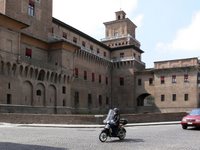

After passing through the walls we came to Viale Cavour and took it straight to the Castello D’Estiense (open Tues-Sun, 9:30am-5:30pm; admission), at one time the home of the powerful Este family who ruled this area and which is now mostly administrative offices, an art gallery and one of the two tourist offices in the city.

But before doing anything else we needed refueling and so we stepped across the street from the castello to the “Art Cafe” (Via Borgo del Leoni) to have a macchiato and dolci while taking in some of this new place.

After we left the café and re-crossed the street we crossed the moat and entered the castle. (A moat? That’s right you medieval fans, they have a real, filled moat with drawbridges for both foot and wheeled traffic and they still work!)

We were all ready to go inside when we found ourselves caught between two large Italian school groups whose teachers were bound and determined to show their students history and art together and so we decided to come back later. In fact Italian school groups are out in force everywhere in Italy this week, particularly since nearly all of the state-run museums in the country are free, a fact we would turn to our advantage on this trip as well.

So we strolled across the courtyard of the castello to the TI office where we picked up a map of the city and plotted out our course for the rest of the morning.

There is actually quite a bit to see and do in Ferrara but our approach to traveling has always been to stroll and take in the city itself, maybe drift into an art gallery or museum if it strikes our fancy, but see the city, watch the people, have coffee, sit down and relax from time to time. Eat a meal.

And of course see the cemetery.

Curiously the enormous “cimitero monumentale” in Ferrara takes up a very large tract of land inside the city walls and, as we would soon discover, was a place for strolling, bike riding as well as connecting up with the past of the city.

So we left the castello and headed north up the Corso D’Este, along wide sidewalks, and very wide cobblestone streets and past meticulously maintain ed low row houses full of color and many with spring plants already out, all very reminiscent Susan thought of Colonial Williamsburg.
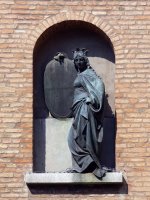

Along the way we came across the Museum of the Risorgimento (“resurgence”) and Resistance in Ferrara. (The Risorgimento was the beginning of Italy’s quest for independence and unification in the 19th century. We had seen much of this as well at the awesome and powerful monuments and ossuaries at the Solferino battlefield last year when we stayed near Lake Garda.)


We walked inside and immediately saw the sign, “ingresso gratuito”, “entrance free.” A very nice woman met us at the door and handed us a guide in English (it is so obvious we are not Italian) and in we went.

The museum is not only for the tourist and traveler but a fine resource for the serious researcher of Ferrara’s role in the history of modern Italy as well. They have a wonderful research collection, much of which is out and available to the public for viewing, things such as newspapers, posters, photographs, etc., all arranged chronologically, and easily to find your way from one time period – one conflict if you will – after another.

The museum has a wonderful collection of uniforms, arms, and numerous other artifacts and items covering pretty much all the major periods of resistance in modern Italian history. Since northern Italian was the fulcrum of the resistance movement during World War Two, it is not surprising that you would also find a large collection of truly fascinating materials from the resistance to German occupation. All of the halls and materials are very well marked, although in Italian only (excepting the guide). The Comune di Ferrara operates the museum. (Open Tues-Sat. 9am-6pm; admission.)


From the museum we turned left back on the Corso D’Este and continued our walk north toward the cemetery complex. We passed a lovely park – indeed there is so much green inside the city walls today – and watched a sight so typical of Italy: a woman obviously keen on fashion and style, yet having to wear a bright orange jumpsuit as part of the uniform of a landscape worker.
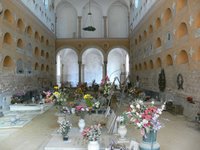

We eventually found ourselves in the cemetery and were immediately struck by the sweeping arcades, the sheer volume of flowers, fresh and otherwise, the unique side-crypts with their dirt floors and wall niches ready for the next urn (yours or mine), the almost city –like feel for this huge complex was itself overwhelming.


While the statuary and mausoleums lacked the power and artistic impressiveness of the Porte Sante in Florence, we did come across something unique in our experience: rosemary bushes as a burial plot decoration.


It appears that within the past year or so there had been a large reorganization and exhumation and subsequent re-inhumation of a large number of bodies. What appeared to have been open broad expanses of land between the sweeping arcades have in effect been turned into new burial grounds for these “re-inhumations”. There are large tracts of burial grounds dedicated to what appears to be plots of land for “cremains” as I think they are called. And each of these very small plots has a stone and then is decorated with a large rosemary bush! And when you add in the flowers from the families and friends the entire scene is a feast for the senses.

After strolling in the cemetery for an hour or so we left and headed to the nearby Jewish cemetery which although appeared close on the map we had to go in a rather roundabout fashion. This was a good thing though. Ferrara has set aside a large amount of land inside the walls for gardens and a nice walking park, all designed to try and recapture a flavor of what this part of the city was like more than a half a millennia ago when it was largely used for cultivation of one type or another.

Anyway the entire experience made us feel as if we were out on a stroll through the countryside and it was hard to imagine we were still inside the city. After wandering around this wonderful country looking for the Jewish cemetery we finally stopped to ask directions to the “Cimitero ebraico” from a postal carrier.

Ten minutes later we were standing in front of this enormous gate, and at the suggestion of a workman just closing the gate behind him we rang the bell. We were soon met by another very nice older woman who showed us inside, had us sign the guestbook (no names from outside of Italy we noted), and after she placed a yarmulke on my head we strolled through a small door into large expanse of open field that was, well, mostly empty.

There were several burial plots all of which were near the gate: flat stones as well as several mausoleums representing families of course. The “Cavalieri” monument, however, was particularly striking, flanked by two powerful eagles, it was dedicated to Pietro, Giuseppe and Clara. Pietro had been awarded the silver medal presumably for bravery while Clara had been awarded the gold medal.

To add further to the mystery Clara was listed as a member of the “P.I.”, possibly the partisan organization in Ferrara and after her name in large letters was the word “Archivolti”, an architectural term in English it is Archivolt, and means “a band of molding, resembling an architrave, around the lower curve of an arch.” She died in 1945 presumably during the war. Their stories of strength and heroism in the face of overwhelming odds are only hinted at in the few words etched in stone and one can only wonder are there people still like that here today?


After we paid our respects at the Jewish cemetery we headed south back toward the center of town, took a break in the Piazza Aristeo (that's it in the photo) and then pushed on toward the castello and the medieval quarter. We skirted to the left of the castello and strolled down Corso Martiri della Liberta’ (Street of the martyrs to liberty”, and rather coincidental given where we had just been) to the Piazzale Cattredale, the city’s central Duomo across from which is the Palazzo Muncipale, the seat of local government.

On the ground floor of the Palazzo is the Café Leone D’Oro where we stopped for lunch. Susan had a tasting menu, six small portions of some of the local specialties, a couple of cheeses, polenta, a gratin and a small group of local mushrooms in a light sauce. Tasty. I had the pasticcio, a pie filled with pasta and béchamel sauce. Man oh man was that good.

After we relaxed over coffee and enjoyed just being alive and in Italy we left the café, turned down the tiny Via Adelardi, just to the left of the Duomo entrance and headed off to explore the eastern side of the historic part of the city. In particular we were off to pay our respects to one of history’s icons of controversy, Lucrezia Borgia.

Via Adelardi becomes Via Voletapaletto, which soon becomes Via Savonarola and just after passing the church of San Francesco, we turned right down Via Pergolato. About 100mts down the street on the right hand side is a small nondescript door with a sign informing us that the monastery church of Corpus Domini, where Lucrezia and a number of other Este family members are buried, is open from 9:30am-12 and then 4-5:30pm (no admission, donations welcome). Lucrezia had been married to Alfonso I, one of the Este dukes. Since it was only a little after 3:00 pm we decided to stroll toward the eastern side of the walls and then come back when the church reopened.

We retraced our steps to Via Savonarola, walked past his house – one cannot help but remark on the fascinating physical closeness between these two controversial and much maligned figures from the middle ages – and walked to the walls, strolling past a large abandoned military complex.

The walls today are impressive from the outside, at least in some places, but from the inside resemble just a small bit of hill, which seems to have been strategically placed to simply cut down the view to the horizon.

We returned westward, this time going back along Via Scandiana, where one can easily see the more egregious effects of the military installation abandonment. Odd given that the city seems so orderly and clean and neat otherwise.

Anyway as we were walking down Via Scandiana we came upon Palazzo Schifanoia (“SKEE-fah-noy-yah”), one of the grandest of the Este ducal palaces. The singular reason for stopping here is to see the “Room of Months.” Located on the upper floor this enormous salon is truly spectacular. The walls, probably 30 feet high, were at one time totally covered with court scenes and those that remain (which have been carefully restored) are absolutely stunning. Breathtaking I think would be an apt term here.

As you leave the palazzo go out the back and there you will find a gorgeous picnicking area with a bar and bookshop in the back garden; a wonderful place to relax. And they make a point of prohibiting school groups from sprawling all over the grounds. That’s a plus right there. (Via Scandiana, 23, open Tues-Sun 9-6; admission.)

It was a little after 4:00 pm when we left the Palazzo Schifanoia and so we he headed back to Corpus Domini. When we got to the little door it was locked so we rang the buzzer. A woman’s voice asked us in Italian what we wanted and we said we wanted to see the tomb of Lucrezia Borgia. She (the woman not Lucrezia) asked us if we spoke Italian. We said yes, a bit. She then instructed us to go around the church and she would let us in through the main door to the church.

So we walked around the corner onto Via Campofranco and used the large knocker on the door. While we were standing there waiting for something to happen an older gentleman was watching us from halfway down the block. When I glanced down his way he would smile and wave for us to stay put. He stayed there while we stood in front of the door – I would glance back, he would smile and wave. This seemed to go on for some time and then we heard the magical sound of the door being unlocked from somewhere off in the recesses of the church. We walked in through the vestibule and to the left a bit off along the wall of the small church was an aged nun, hunch-backed behind a wall of bars who told us to close the door and come in. She then pointed to a door at the far end from where we were standing, around the corner of the altar and motioned for us to go through it which of course we did. (She’s a nun after all, you have to do what she says.)

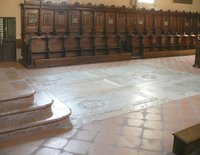
We came into a small chapel directly behind the altar of the little church and on the far wall was another small set of bars behind which the nun remained and told us to look in the center of the floor. Sure enough there were six marble slabs, two rows of three, and our hostess commenced to tell us who was in each one. Lucrezia’s tomb was in the “center of the top” row, nearest the steps to the wall and she was in fact buried with five other people: her husband Alfonso I, Eleonora of Aragon (mother of Alfonso I, I believe), Alessandro, son of Lucrezia and Alfonso, Lucrezia’s infant daughter Isabella, and Alfonso II, the last Este duke. (Of course their remains are in the crypt below, a place that I would have liked to have seen but felt it would have been out of the question for me to ask.)

After our guide finished her story we she asked us if we knew who Mary was, the mother of Jesus. We said yes we knew who she was. She then gave us a tiny medal clipped to a safety pin and informed us it would protect us. Naturally we left a donation.


We left the church and continued our stroll through the medieval quarter eventually working our way back to the Piazza Cattredale, and the center of the historic downtown, where there were campaign speeches and songs blaring to keep reminding us that this weekend is the big vote for Italy. But for us we just walked, window-shopping, and just watching the people go about their lives. We peeke dinside the duomo just as mass was getting underway.

A little before 6:00 pm we started to head back to the train station. We caught the 6:47 train, which was on time and found ourselves back in Florence by 8:30. We strolled home and by 9:00 pm were back in the apartment where we decided to just relax for the evening.

General impressions:

Parking and driving is a breeze, or so it appeared to us and walking did not require any particular survival skills. Although we missed a number of recommended venues for art I would recommend you grab a good guidebook and check things out for yourself. (We used the Rough Guide to Italy.) And certainly stop at the TI office before beginning your local trek. Oh, and it would appear that like many other parts of Italy most museums and attractions are close don Monday.

Food costs are quite a bit lower than in Florence of Tuscany and I suspect that may also be the case for lodging but not certain on that point.

Ferrara is clean, quiet, orderly and more akin to the kind of place we would feel most comfortable in spending the next few years of our lives. No tourists, or rather very few, and virtually no dog poop or pigeon droppings either. It would be a great place to break up a trip wedged between the intensity usually experienced by the harried traveler to Venice or Florence.

Anyway, for additional photos from our recent Ferrara day trip, click here.

Wish you were here,

Steve

Ferrara Special Report 2006

It certainly is a strange world sometimes and it’s funny how some things which appear fairly meaningless fulfill some kind of destiny all their own.

Take Savonarola for example (that's him in the photo).

On our very first trip to Florence, more than 12 years ago, we stood on the very spot where Girolamo Savonarola, the Medici-hating, reformist, fanatical monk was burned alive along with two associates after a short spin as head of Florentine government. Now cut to the winter of 2006. On our first outing in Florence in early February we stopped at the church and monastery of San Marco to see the work of Fra Angelico and also visited the very cell where Savonarola was living and working when he was dragged out to be tried, convicted and burned at the stake.

And then on Friday, April 7, 2006, we stood in front of the house at no. 19 Via Savonarola in Ferrara, Italy, where Savonarola was born and lived the first twenty years of his life – and is now used by the local university as a theater for students to present just the kind of art which would of course have the old monk spinning in his grave, except that his grave is the depths of the Arno river.

Lest you interpret all this as some sort of hero-worship, when it comes to burned monks, I much prefer Bruno Giordano who was burned at the stake for heresy; he believed that people should be allowed to make up their own minds about things, not a welcome idea among the church faithful at the time. His statue sits squarely in the center of the Campo d’Fiori, one of our most favorite piazzas in all of Rome – and where he was executed.

Given short shrift by most of the “mass market” guidebooks, Ferrara, about 30 minutes north of Bologna and 90 minutes north of Florence, is a gorgeous city in the Po delta complex and worth a long day trip or perhaps an overnight. And just to the north is Padova and then Venice; to the west and north and easily reached by train are Verona and Mantova. And since Ferrara sits right on the main train line from Bologna to Venice getting there is no problem.

We took an 8:47 train on a beautiful, sunny but crisp morning from Florence and after a brief stop in Bologna pulled into the Ferrara station a little after 10:00 am; our return wasn’t until nearly 7:00 pm so we had plenty of time to explore the historic city center. (Note: there is construction at the station and the bathrooms, “WCs”, have been temporarily relocated to the portajohns next to the bar – with your back to the tracks go right around the station and voila.)

From the train station to the historic center was an easy 15-minute walk. Out of the station we turned left and then followed the curving boulevard around to the right until we passed through the old city walls. Although not as dramatic as, say, the walls that encircle Lucca, Ferrara’s city walls pretty much ring the historic center and you can walk them with ease. (Bicycles are also very popular here as well.) They also appear to provide a reasonably good elevation from which to view the city.


After passing through the walls we came to Viale Cavour and took it straight to the Castello D’Estiense (open Tues-Sun, 9:30am-5:30pm; admission), at one time the home of the powerful Este family who ruled this area and which is now mostly administrative offices, an art gallery and one of the two tourist offices in the city.

But before doing anything else we needed refueling and so we stepped across the street from the castello to the “Art Cafe” (Via Borgo del Leoni) to have a macchiato and dolci while taking in some of this new place.

After we left the café and re-crossed the street we crossed the moat and entered the castle. (A moat? That’s right you medieval fans, they have a real, filled moat with drawbridges for both foot and wheeled traffic and they still work!)

We were all ready to go inside when we found ourselves caught between two large Italian school groups whose teachers were bound and determined to show their students history and art together and so we decided to come back later. In fact Italian school groups are out in force everywhere in Italy this week, particularly since nearly all of the state-run museums in the country are free, a fact we would turn to our advantage on this trip as well.

So we strolled across the courtyard of the castello to the TI office where we picked up a map of the city and plotted out our course for the rest of the morning.

There is actually quite a bit to see and do in Ferrara but our approach to traveling has always been to stroll and take in the city itself, maybe drift into an art gallery or museum if it strikes our fancy, but see the city, watch the people, have coffee, sit down and relax from time to time. Eat a meal.

And of course see the cemetery.

Curiously the enormous “cimitero monumentale” in Ferrara takes up a very large tract of land inside the city walls and, as we would soon discover, was a place for strolling, bike riding as well as connecting up with the past of the city.

So we left the castello and headed north up the Corso D’Este, along wide sidewalks, and very wide cobblestone streets and past meticulously maintain ed low row houses full of color and many with spring plants already out, all very reminiscent Susan thought of Colonial Williamsburg.


Along the way we came across the Museum of the Risorgimento (“resurgence”) and Resistance in Ferrara. (The Risorgimento was the beginning of Italy’s quest for independence and unification in the 19th century. We had seen much of this as well at the awesome and powerful monuments and ossuaries at the Solferino battlefield last year when we stayed near Lake Garda.)


We walked inside and immediately saw the sign, “ingresso gratuito”, “entrance free.” A very nice woman met us at the door and handed us a guide in English (it is so obvious we are not Italian) and in we went.

The museum is not only for the tourist and traveler but a fine resource for the serious researcher of Ferrara’s role in the history of modern Italy as well. They have a wonderful research collection, much of which is out and available to the public for viewing, things such as newspapers, posters, photographs, etc., all arranged chronologically, and easily to find your way from one time period – one conflict if you will – after another.

The museum has a wonderful collection of uniforms, arms, and numerous other artifacts and items covering pretty much all the major periods of resistance in modern Italian history. Since northern Italian was the fulcrum of the resistance movement during World War Two, it is not surprising that you would also find a large collection of truly fascinating materials from the resistance to German occupation. All of the halls and materials are very well marked, although in Italian only (excepting the guide). The Comune di Ferrara operates the museum. (Open Tues-Sat. 9am-6pm; admission.)


From the museum we turned left back on the Corso D’Este and continued our walk north toward the cemetery complex. We passed a lovely park – indeed there is so much green inside the city walls today – and watched a sight so typical of Italy: a woman obviously keen on fashion and style, yet having to wear a bright orange jumpsuit as part of the uniform of a landscape worker.


We eventually found ourselves in the cemetery and were immediately struck by the sweeping arcades, the sheer volume of flowers, fresh and otherwise, the unique side-crypts with their dirt floors and wall niches ready for the next urn (yours or mine), the almost city –like feel for this huge complex was itself overwhelming.


While the statuary and mausoleums lacked the power and artistic impressiveness of the Porte Sante in Florence, we did come across something unique in our experience: rosemary bushes as a burial plot decoration.


It appears that within the past year or so there had been a large reorganization and exhumation and subsequent re-inhumation of a large number of bodies. What appeared to have been open broad expanses of land between the sweeping arcades have in effect been turned into new burial grounds for these “re-inhumations”. There are large tracts of burial grounds dedicated to what appears to be plots of land for “cremains” as I think they are called. And each of these very small plots has a stone and then is decorated with a large rosemary bush! And when you add in the flowers from the families and friends the entire scene is a feast for the senses.

After strolling in the cemetery for an hour or so we left and headed to the nearby Jewish cemetery which although appeared close on the map we had to go in a rather roundabout fashion. This was a good thing though. Ferrara has set aside a large amount of land inside the walls for gardens and a nice walking park, all designed to try and recapture a flavor of what this part of the city was like more than a half a millennia ago when it was largely used for cultivation of one type or another.

Anyway the entire experience made us feel as if we were out on a stroll through the countryside and it was hard to imagine we were still inside the city. After wandering around this wonderful country looking for the Jewish cemetery we finally stopped to ask directions to the “Cimitero ebraico” from a postal carrier.

Ten minutes later we were standing in front of this enormous gate, and at the suggestion of a workman just closing the gate behind him we rang the bell. We were soon met by another very nice older woman who showed us inside, had us sign the guestbook (no names from outside of Italy we noted), and after she placed a yarmulke on my head we strolled through a small door into large expanse of open field that was, well, mostly empty.

There were several burial plots all of which were near the gate: flat stones as well as several mausoleums representing families of course. The “Cavalieri” monument, however, was particularly striking, flanked by two powerful eagles, it was dedicated to Pietro, Giuseppe and Clara. Pietro had been awarded the silver medal presumably for bravery while Clara had been awarded the gold medal.

To add further to the mystery Clara was listed as a member of the “P.I.”, possibly the partisan organization in Ferrara and after her name in large letters was the word “Archivolti”, an architectural term in English it is Archivolt, and means “a band of molding, resembling an architrave, around the lower curve of an arch.” She died in 1945 presumably during the war. Their stories of strength and heroism in the face of overwhelming odds are only hinted at in the few words etched in stone and one can only wonder are there people still like that here today?


After we paid our respects at the Jewish cemetery we headed south back toward the center of town, took a break in the Piazza Aristeo (that's it in the photo) and then pushed on toward the castello and the medieval quarter. We skirted to the left of the castello and strolled down Corso Martiri della Liberta’ (Street of the martyrs to liberty”, and rather coincidental given where we had just been) to the Piazzale Cattredale, the city’s central Duomo across from which is the Palazzo Muncipale, the seat of local government.

On the ground floor of the Palazzo is the Café Leone D’Oro where we stopped for lunch. Susan had a tasting menu, six small portions of some of the local specialties, a couple of cheeses, polenta, a gratin and a small group of local mushrooms in a light sauce. Tasty. I had the pasticcio, a pie filled with pasta and béchamel sauce. Man oh man was that good.

After we relaxed over coffee and enjoyed just being alive and in Italy we left the café, turned down the tiny Via Adelardi, just to the left of the Duomo entrance and headed off to explore the eastern side of the historic part of the city. In particular we were off to pay our respects to one of history’s icons of controversy, Lucrezia Borgia.

Via Adelardi becomes Via Voletapaletto, which soon becomes Via Savonarola and just after passing the church of San Francesco, we turned right down Via Pergolato. About 100mts down the street on the right hand side is a small nondescript door with a sign informing us that the monastery church of Corpus Domini, where Lucrezia and a number of other Este family members are buried, is open from 9:30am-12 and then 4-5:30pm (no admission, donations welcome). Lucrezia had been married to Alfonso I, one of the Este dukes. Since it was only a little after 3:00 pm we decided to stroll toward the eastern side of the walls and then come back when the church reopened.

We retraced our steps to Via Savonarola, walked past his house – one cannot help but remark on the fascinating physical closeness between these two controversial and much maligned figures from the middle ages – and walked to the walls, strolling past a large abandoned military complex.

The walls today are impressive from the outside, at least in some places, but from the inside resemble just a small bit of hill, which seems to have been strategically placed to simply cut down the view to the horizon.

We returned westward, this time going back along Via Scandiana, where one can easily see the more egregious effects of the military installation abandonment. Odd given that the city seems so orderly and clean and neat otherwise.

Anyway as we were walking down Via Scandiana we came upon Palazzo Schifanoia (“SKEE-fah-noy-yah”), one of the grandest of the Este ducal palaces. The singular reason for stopping here is to see the “Room of Months.” Located on the upper floor this enormous salon is truly spectacular. The walls, probably 30 feet high, were at one time totally covered with court scenes and those that remain (which have been carefully restored) are absolutely stunning. Breathtaking I think would be an apt term here.

As you leave the palazzo go out the back and there you will find a gorgeous picnicking area with a bar and bookshop in the back garden; a wonderful place to relax. And they make a point of prohibiting school groups from sprawling all over the grounds. That’s a plus right there. (Via Scandiana, 23, open Tues-Sun 9-6; admission.)

It was a little after 4:00 pm when we left the Palazzo Schifanoia and so we he headed back to Corpus Domini. When we got to the little door it was locked so we rang the buzzer. A woman’s voice asked us in Italian what we wanted and we said we wanted to see the tomb of Lucrezia Borgia. She (the woman not Lucrezia) asked us if we spoke Italian. We said yes, a bit. She then instructed us to go around the church and she would let us in through the main door to the church.


So we walked around the corner onto Via Campofranco and used the large knocker on the door. While we were standing there waiting for something to happen an older gentleman was watching us from halfway down the block. When I glanced down his way he would smile and wave for us to stay put. He stayed there while we stood in front of the door – I would glance back, he would smile and wave. This seemed to go on for some time and then we heard the magical sound of the door being unlocked from somewhere off in the recesses of the church. We walked in through the vestibule and to the left a bit off along the wall of the small church was an aged nun, hunch-backed behind a wall of bars who told us to close the door and come in. She then pointed to a door at the far end from where we were standing, around the corner of the altar and motioned for us to go through it which of course we did. (She’s a nun after all, you have to do what she says.)

We came into a small chapel directly behind the altar of the little church and on the far wall was another small set of bars behind which the nun remained and told us to look in the center of the floor. Sure enough there were six marble slabs, two rows of three, and our hostess commenced to tell us who was in each one. Lucrezia’s tomb was in the “center of the top” row, nearest the steps to the wall and she was in fact buried with five other people: her husband Alfonso I, Eleonora of Aragon (mother of Alfonso I, I believe), Alessandro, son of Lucrezia and Alfonso, Lucrezia’s infant daughter Isabella, and Alfonso II, the last Este duke. (Of course their remains are in the crypt below, a place that I would have liked to have seen but felt it would have been out of the question for me to ask.)

After our guide finished her story we she asked us if we knew who Mary was, the mother of Jesus. We said yes we knew who she was. She then gave us a tiny medal clipped to a safety pin and informed us it would protect us. Naturally we left a donation.


We left the church and continued our stroll through the medieval quarter eventually working our way back to the Piazza Cattredale, and the center of the historic downtown, where there were campaign speeches and songs blaring to keep reminding us that this weekend is the big vote for Italy. But for us we just walked, window-shopping, and just watching the people go about their lives. We peeke dinside the duomo just as mass was getting underway.

A little before 6:00 pm we started to head back to the train station. We caught the 6:47 train, which was on time and found ourselves back in Florence by 8:30. We strolled home and by 9:00 pm were back in the apartment where we decided to just relax for the evening.

General impressions:

Parking and driving is a breeze, or so it appeared to us and walking did not require any particular survival skills. Although we missed a number of recommended venues for art I would recommend you grab a good guidebook and check things out for yourself. (We used the Rough Guide to Italy.) And certainly stop at the TI office before beginning your local trek. Oh, and it would appear that like many other parts of Italy most museums and attractions are close don Monday.

Food costs are quite a bit lower than in Florence of Tuscany and I suspect that may also be the case for lodging but not certain on that point.

Ferrara is clean, quiet, orderly and more akin to the kind of place we would feel most comfortable in spending the next few years of our lives. No tourists, or rather very few, and virtually no dog poop or pigeon droppings either. It would be a great place to break up a trip wedged between the intensity usually experienced by the harried traveler to Venice or Florence.

Wish you were here,

Steve

Chihuly in the Japanese Garden

We returned to Meijer Gardens recently to finish off our tour of the Chihuly sculptures, this time focusing on the Japanese Garden. new take...