(
This is reprinted from my September 28, 2006 post. Please forgive the low quality of the photography.)
The
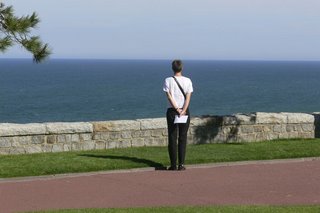
Beaches. Omaha, Utah, Juno, Sword and Gold. The very names themselves are italicized inour collective consciousness. Walking these beaches today you’d never know the perfectly horrible and perfectly heroic things that happened on that one summer day along this stretch of sand and grass on the western coast of France, not terribly far from where a Norman fleet left to invade England nearly a thousand years ago. In fact as you casually stroll along at low tide when there is such a broad expanse of beach exposed, watching kids play like they do on beaches everywhere, watching families out taking in the fresh air and stretching their legs, maybe after a day of work in the office or bicycling up and down these country roads, as your eye wanders along the shoreline catching the rows of small, modest but well-maintained summer homes which seem to dominate the landscape, you must wonder “did it all ever truly happen”? (
photo: Susan contemplating Omaha beach from the American cemetery.)
And then you come to the cemetery, or rather cemeteries, for there isn’t just one or two but some two dozen scattered throughout this part of Normandy: British, American, Canadian (who are after all Americans too), Polish, and of course Germans, lots of Germans.
We began our first the morning in Normandy, September 23rd with a leisurely breakfast at the B & B, where we met another American couple, who were from Colorado and who had just finished a week-long bike tour in Provence and were up in Normandy doing some biking on their own. Anyway we had a nice chat with them, but they had miles to peddle and we all had the beaches to see.
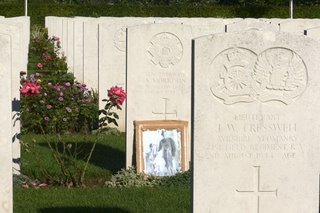
Susan and I started out by driving into Bayeaux where we paid a visit to the British cemetery there, located just across from the Normandy Battle Museum (the large tank out front is a giveaway that a museum is close by). To us the cemeteries are the real museums. Hardware is all well and good and of course a necessary element in this enormous story but the real stories lie out there under the simple headstones, under the white crosses and the stars of David.
We strolled a bit, reading some of the sentiments on the stones. The Commonwealth policy was to permit every buried soldier’s family to express their final sentiments on the headstone. A very civilized and poignant gesture of respect we thought. (The Commonwealth War Graves Commission maintains 17 seventeen cemeteries in the area. You can find out more at their website, just
click here.)
A word or two about the museums might be in order here.
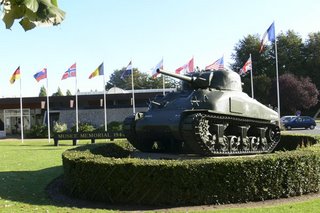
Unlike in the US (for example), where a museum on a battlefield is usually part of a larger park system, in Normandy they are not. There are large museums and quite a few smaller ones as well scattered throughout the beaches area; the small ones tend to be specialized with collections often made up of items scrounged off the beaches and from the surrounding farms after the war. Anyway, one could easily spend a great deal of time and money wandering through these places which are mainly large collections of hardware with varying levels of effort made to interpret the D-Day story. Moreover, to further confuse matters D-Day was of course just, well, one day. The Normandy story spans far more territory and covers many more weeks than just what happened on the Beaches of course. Museums that might be worth a stop are: the Normandy battle museum in Bayeaux, the museum in Arromanches which deals largely with the British landings and also has a truly wonderful display covering the Mulberry harbor created for D-Day and after, the museums at both Omaha and Utah beaches, as well as the US Airborne museum in Ste-Mere-Eglise. There is apparently a substantial visitor center under construction next to the American cemetery overlooking Omaha beach. (
photo above: Normandy battle museum in Bayeaux.)
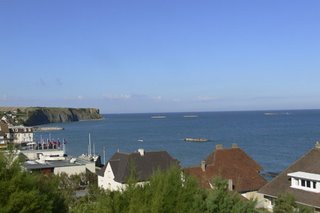
After leaving the British cemetery we drove around Bayeaux and headed off to Arromanches, located right on Gold beach, which was part of the Commonwealth beachhead on June 6. We parked the car and walked down to the waterfront. One can still see remnants of the manmade harbor, code-named Mulberry, which was made in England and then towed over to Normandy to create an enormous port facility which extended out from the small shoreline. This harbor system was in turn protected by another manmade creation, a massive breakwater which was also produced in England and towed over in pieces as well. These were both truly amazing feats of engineering and critical to the success of the entire Normandy campaign. In order to appreciate this massive undertaking it is well worth a stop in the museum located right along the water.

From the museum we strolled to the bluffs overlooking the harbor for a really spectacular view of what is left of the Mulberry system. And since it was a gorgeous day, just about as perfect as we could have hoped for, with warm temps, a fine breeze and plenty of sun alternating with shade, any excuse to be outside strolling worked for us. (
photo right: remnants of Mulberry at Arromanches.)
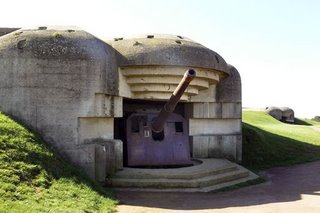
Leaving Arromanches we headed west toward the German battery at Longue-sur-Mer, just a few kilometers outside of town. Following good signage – and with a handy map we had bought at the Bayeaux visitor center -- we soon found ourselves in a small car park near the German guns. We got out and strolled over to the complex of four enormous gun emplacements, three pretty much intact the guns still in place. Amazing. Most of the original trench and tunnel complexes are gone now or buried beneath debris, but there is just enough remaining to bring you chillingly close to what had happened here. And we just looked out toward that calm blue sea and wondered what it must have been like for the Germans manning these guns when they first saw that enormous armada of thousands of ships heading straight toward them, loaded with the men and material to do them terrible, and probably fatal harm. What thoughts went through their minds, we wondered?
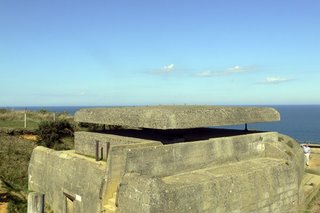
From the “German Battery” we drove down into Port-en-Bessin and stopped for a rather mediocre lunch across from a line of fishing and salvage boats moored there for the day. (The restaurant was kind enough to plug my camera battery charger in however.) But it was a gorgeous day and we were on the trip of a lifetime. (
photo right: German battery command post.)
After lunch we drove to the American cemetery at Colleville-St-Laurent-sur-Mer. (Most of the towns around here have the added suffix “sur-mer”which simply means “on the water.”)
One of a dozen or so US cemeteries in France, this is the only American cemetery remaining in Normandy, and sits on a beautiful bluff overlooking Omaha beach, the very bluff which was packed with Germans on June 6, 1944. The first cemetery was right on Omaha beach just a few kilometers away from the present cemetery (today the small marker is nearly surrounded by vacation homes).

The land for this 172-acre cemetery was given by France to the United States, and has the status of a US Territory. Some 9,350 burials were completed by1949 and today it is the second largest American cemetery in France (after Lorraine with a little more than 10,000 interments). Along with our visit to the Canadian cemetery (see below) this is probably one of the most stirring sites of the entire Beach complex and certainly attracts a great many visitors from all over the world. The cemetery is powerful and almost overwhelming in its layout, although I thought the wall of names of those men whose bodies were never found was a bit hidden from view behind the wonderful statue of "American youth rising."
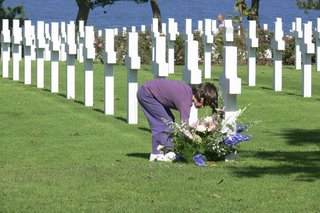
And the music played every hour on the hour, hymns and the national anthem, is very touching. (Although I did wonder to myself if the guys might like to hear a little Glen Miller maybe or Tommy Dorsey.) The striking thing we thought, aside from the beautiful location on the bluffs overlooking Omaha with a superb view of the water, is the row after row after row of markers dated June 6, June 7, June 6, June 6 . . . Incredible. (You can find out more online, just
click here.)
From the American cemetery we drove down to the western end of Omaha beach and were immediately struck by the fantastic stainless steel monument sitting almost in the water. It is enormous and yet graceful at the same time. Watching children and families playing around it only made its reason for being there on the beach all the more poignant.
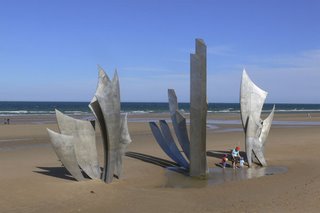
We returned to the car and drove slowly along the beach road fronting what was “Dog” sector of the beach, looking for the small monument marking the site where they first started burying the dead along Omaha at a little before 9 am on June 6.
We soon found the small marker, surrounded by a well-kept row of hedges, but making it almost invisible to anyone not looking for it. The fact that it was also surrounded by a row of summer homes made us feel uneasy and yet comfortable at the same time: uneasy that somehow this spot might be forgotten and yet comfortable in the knowledge that life goes on and maybe for the better this time. Who knows?
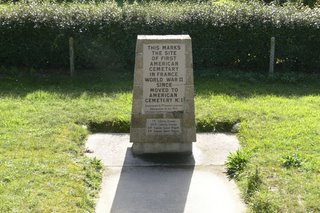
From Omaha beach we returned back up to the bluffs and drove a few short kilometers to Pointe-du-Hoc, a headland of sheer cliffs, which a unit of Rangers had climbed up, taking the Germans by surprise on June 6.
The area has been left pretty much as it was then, a scarred and pockmarked landscape with the ruins of the German bunkers still evident today. The memorial to the Rangers, which is located just overlooking the beach, is off-limits today.
There is no reason given but we thought maybe the ground has become unstable.

After leaving Pointe-du-Hoc we drove up to Utah beach. The museum looked tired and in need of renovation, while the parking area was otherwise isolated except for a pair of little kitschy cafes selling hot dogs, soft drinks, beers and oddly enough internet access, all amidst a wide flat plain with nothing else in sight. Quite depressing actually. Oh and the bathrooms were inside an old German bunker built into the side of the dunes behind the beach. An interesting experience to say the least. And there was very little in the way of interpretive signage -- even the huge but terribly plain US monument seemed as devoid of life as the parking lot it faced. The beach itself was peaceful enough though, with occasional scatterings of anti-tank defenses still strewn about. A little ways up the beach we stopped at the memorial to the Free French forces under Gen. LeClerc who also landed near here. The tattered US and French flags flying from their poles overlooking the monument to the Frenchmen who came back spoke volumes we thought.
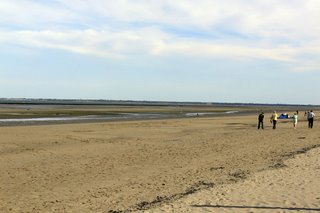
After leaving Utah beach we drove to Ste-Mere-Eglise, where we saw the effigy of paratrooper John Steele hanging from the steeple of the church on the main square and across the street from the Airborne museum (the 82nd dropped into this area during D-Day). Steele was one of the few survivors of that drop into Ste-Mere-Eglise; he survived by feigning death after his parachute got hung up in the steeple of the church.
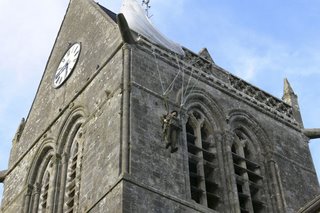
So much to see and so little time -- time that great leveler again!
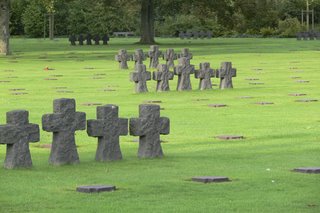
It was getting late so we headed back south toward our B & B near Mosles. But along the way, from the busy 4-lane N13 highway we saw the entrance to the German cemetery at La Cambe and quickly took the next exit. We had discussed earlier whether we wanted to stop at one of the German cemeteries (there are in fact six in this part of France). I can’t begin to tell you how glad we were that we stopped because what we saw and learned was moving in the extreme. The entrance to the German cemetery is almost claustrophobic but gives a striking view of the cemetery’s centerpiece, a large 6-meter high tumulus which is the burial ground for more than 200 unknown dead and another 89 of whom are known by name and listed on plaques around the base. The tumulus overlooks the graves of more than 21,000 German soldiers buried beneath small flat crosses, which are laid softly in the grass, surrounded by a occasional sets of upright crosses scattered throughout the cemetery. Subtle but very powerful nonetheless.
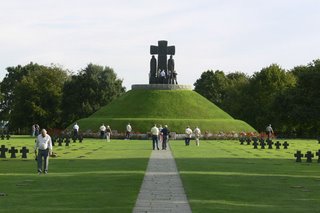
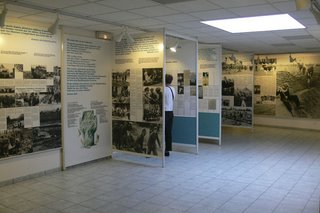
The most moving part of the German cemetery at La Cambe lies across the parking lot in the information building that overlooks busy N13. Inside there is a truly awesome display of letters, telegrams and photos arranged as a series of stories told by local civilians, German and Allied soldiers, all who suffered here in that June of 1944. Surprising as it may sound words fail to do justice to our feelings. Take for example the letter from a German father to a priest in Normandy in the late 1940s inquiring about his son’s grave. His son, a fighter pilot had died in a crash and had been buried in the priest’s churchyard.
The priest wrote back saying that the American Graves Services people had come and exhumed the body and reburied it in one of the cemeteries designated for German dead. There was even the note from the Americans to the father reporting the grave’s location. Or the notes form the young woman who had live din one of the nearby villages and who described the horrors suffered by the local population from both Allied and German shelling and bombing.
The entire display served one purpose, to make us remember these were real people who died during those terrible days in June of 1944; fathers, sons, brothers, but also more than 14,000 civilians were killed during the fighting for Normandy. The
German War Graves Commission is determined to remind us of “the terrible consequences of war” and “how important it is to work for peace.” Right to the point.
What a way to end the day. And what a day it was.
Wish you had been there, and I hope you’ll go there. Soon.
Steve


 Susan and I started out by driving into Bayeaux where we paid a visit to the British cemetery there, located just across from the Normandy Battle Museum (the large tank out front is a giveaway that a museum is close by). To us the cemeteries are the real museums. Hardware is all well and good and of course a necessary element in this enormous story but the real stories lie out there under the simple headstones, under the white crosses and the stars of David.


 And the music played every hour on the hour, hymns and the national anthem, is very touching. (Although I did wonder to myself if the guys might like to hear a little Glen Miller maybe or Tommy Dorsey.) The striking thing we thought, aside from the beautiful location on the bluffs overlooking Omaha with a superb view of the water, is the row after row after row of markers dated June 6, June 7, June 6, June 6 . . . Incredible. (You can find out more online, just click here.)


 Simple.
 Marat's house has also gone and rue des Cordeliers is now the rue de L'Ecole de Medicines and in fact the entire block has been incorporated into the University of Paris Medical School. (The building that housed the old and venerable Cordeliers Club does exist however.)
 The Place de la Revolution is now the Place de la Concorde and here Charlotte would certainly recognize the two large imposing buildings at the northern side since they existed in her time as well.

 The location of the mass grave is today remembered by La Chapelle Expiatoire and is located on the bustling Boulevard Haussmann in the middle of one of the busiest shopping districts of Paris. The remains of Louis and Marie Antoinette were eventually removed to the ancient royal tombs at St. Denis.
 Chauveau-Lagarde went on to defend many of the city's leading monarchists, the most famous of course was the queen herself, Marie Antoinette. Although his life was at risk many times during the Reign of Terror, Chauveau-Lagarde survived it all and died in Paris in 1841. He is buried in Montparnasse cemetery.


