It’s been a rather chilly, overcast Sunday so far. (You can tell it’s Sunday by the incessant tolling of bells reminding folks to go to Mass. That and of course by looking at the calendar.) It’s a household chore day here, laundry and housecleaning before we head off tomorrow to Napoli for a few days during Susan’s spring break. We then hope to get down to Siena Friday or maybe over the weekend.
Susan finished her last midterm on Thursday and on Friday we took the no. 7 bus from Piazza San Marco, just around the corner from the Accademia and our apartment, up to Fiesole, a ride of about 15 minutes or so. It was a beautiful sunny day, although a bit chilly and blustery, when we headed for the hills above Florence but it was a blast to be back there after nearly 12 years. (The last time we were there was in 1994 with Dick and Dorothy and we’re not sure if we had changed or the town had changed but some things definitely looked very different. I suppose it was the huge construction wall surrounding the main piazza that threw us off. Ugly is an understatement here.)
Perched high above Florence, the Etruscans had settled Fiesole more than two-and-a-half millennia ago and parts of their city are still there as is their amphitheater, which is still used for plays and concerts. (I mean will the Houston Astrodome be around in a couple of thousand years?)
While it was sunny the haze prevented any decent photography so we just strolled around the top of the mountain and then returned to Piazza Mino where the bus stop is and sat outside and had a bite of lunch. It was the first time we sat outside to eat since last October and it felt great to enjoy the sun at the same time we were enjoying good food and wine.
Aside from the view and the bit (very little bit really) of Etruscan ruins there is little to detain the traveler in Fiesole. The nearby cemetery looked interesting but appeared devoid of any statuary and seemed primarily packed with row upon row of headstones; in any case was closed when we were there. Still it was good to return and the bus ride was most enjoyable. We continue to experience and see more of the city. After all we are going to be here for another four months, and possibly longer.
About 8:30 Saturday morning we headed over to the Santa Maria Novella train station and caught the Eurostar to Bologna. We used the Italian railway’s website to order our tickets in advance and even though we went second class we had to buy reserved seats when using the Internet – which as it turned out was a good thing. The trains going and returning were packed and lots of folks who didn’t have seats reserved spent part of their time aboard looking for open seats after each stop.
Here let me put in a couple of unpaid plug for Trenitalia, the Italian railway system, and in particular for the Eurostar trains.
First using the internet, which we do nearly all the time now, works like a charm. Order your tickets online and you have the option of going to the station and using the ticket machines to get our purchased tickets (and it worked fine) or, depending upon the train you can just print out the email sent to you by Trenitalia and show it to the conductor on board. They then issue you a ticket. We used this latter method for this trip and it worked great as well. No muss no fuss. Oh and Trenitalia also sent text messages to my mobile phone with all the train information (including reservation number.) for each leg of our trip. Pretty slick. Second, the Eurostar trains are newer than the IR (Interregional), IC (Intercity) and most of the other types as well, and so the facilities are in better shape as well. They also make far fewer stops.
You can now access most Italian city bus systems online and download and print out maps and timetables. Some cities like Bologna for example, even provide an interactive online map. Very helpful to be sure but it also means you spend less time looking for the tourist information office which may or may not be open.
So we arrived at the train station just northwest of downtown Bologna a little after 10 am, pick up a handful of local bus tickets inside the station at the “tabacchi” and cross the street from the station to the major city bus stop and pick up the D bus which will take us to the Porta Saragozza, on the southwest side of the city. (The number 20 will also take you there as well.) When we visited Bologna before we had heard about the world’s longest portico, which climbs to a large hill overlooking the city and so that is one of the two reasons we have returned. The other is that we read about an enormous home show going on in the city and thought we would drop in and see what it was all about. More of that later.
So we got off the D bus at the Porta Saragozza, crossed under the porta -- effectively outside one of the ancient walls of the city. We see the portico directly ahead of us, cross the street and begin our “trek” to the Santuario di Madonna di San Luca. Originally designed for pilgrims who would make the climb to the top of the mountain for worship, the portico, at least, in its initial stages, is lined with shops and caffes as it runs alongside Via Saragozza. After walking for about 15 minutes or so the porotico crosses the road, or rather above the road, and then we begin the most arduous part of the trip: the steep, uphill climb to the Santuario. This is something to clearly bear in mind for this is not for the weak of limb or lazy of bones. This is a serious climb so be prepared.
After 666 arches, nearly 3.5kms (some 2 miles), stripping away half of our clothes, and what seems like four or five hundred thousand steps (well OK maybe not that many but pretty close) we arrived at the top. The views of the northwestern part of the city were pretty dramatic indeed – but the letdown was that we could not see much of the rest of the city – the really great views were in the back of the church, which was apparently inaccessible to the public. But it was a great hike and well worth doing – and I think just to walk the portico is something that should be done by the traveler looking for something different. It is the journey after all, right?
So we walked back down, crossed Via Saragozza and picked up the D bus, (both the D and number 20 busses go up and down Via Saragozza). At the train station we picked up the number 10 bus. After about 10 minutes we got off at the Bologna “Fiera” (“fair”) which is basically an enormous conference and exhibition complex. And enormous is probably an understatement here. The place consisted of some 15 or so pavilions, some larger than a football field, nearly each of which had eating areas and many had multiple stories. Man was this place big.
So we had read about this huge home show that was ending on Saturday, the 18th and thought hey let’s go back to Bologna, walk the portico and check out the home show. Well we get to the home show and the first pavilion we went to, the “Color and Decorating” pavilion, was, you guessed it, all about paint; everything you could possibly want to know about paint: how to make it, how to mix it, and on and on. The pavilion with the wrought iron was designed largely to demonstrate the machinery used in making the wrought iron. OK you get the point.
This was a home show all right, but a show for men and women involved in the trades, for those involved in the building processes and the building supplies aspect of the home construction world. I mean there was one pavilion focusing just on heavy security doors and the like; another on wood and wood processing equipment.
Once again we let our American-based assumptions get the better of us and didn’t read closely enough – I mean after the fact we said to ourselves, it was curious that in the online catalog of exhibitors not one of the appliance companies or makers of bathroom fixtures listed. We agreed we read what we wanted to read – maybe it was just a subconscious excuse maybe to return to Bologna.
Still there were some interesting things to see: the painting of women’s bodies b local artists -- although I’m still not sure what the point was here – it was of course a booth display by the paint company Arco. Of course, for Italians when it comes to women’s bodies just showing them is often the point I suppose. And there was the display of enormous one piece (?) curving staircases; the huge wrought iron grates, to mention just two. But mainly it was lots and lots of equipment and machinery used by the pros. Not an appliance or tablecloth in sight.
We needed a break so we popped into one of the eating areas, grabbed a couple of pannini and relaxed before striking out for the natural stone pavilion. I let Susan tackle that by herself and I found a place to sit and take some photos.
We then grabbed the no. 10 bus and headed back to the train station where caught the 5:46 for home.
We slept for 10 hours. Go figure.
Wish you were here,
Steve

Getting your permesso di soggiorno per stranieri in Florence.

[Caveat: this information was valid for Florence and as of mid-March 2006. I urge you to check with your local Questura for any differences or changes from what I experienced in Florence.]
There is a lot of talk online about the paperwork hassles and nightmarishly lone lines awaiting those foolish enough to think they can deal with the Italian bureaucracy, particularly for foreigners wanting to stay for an extended period of time in Italy. I am here to tell you that this simply isn’t true – at least it wasn’t for me at any rate.
Unlike some Americans I’ve spoken with who had “a friend with friend who knew somebody” I had to go to the local Questura (police station) in Florence to get my permesso di soggiorno per stranieri, my “foreigner’s permit to stay” longer than the “normal time” allotted to tourists (whatever that is).
First, the permesso is NOT a visa, which is in fact attached to your passport and which one needs to apply for at the Italian consulate nearest your place of legal residence. Visas are required by most schools – private language schools are an exception apparently – so this is something you will need to arrange in advance of travel, assuming your school program did not make the visa arrangements for you. There are in fact agencies such as Study Abroad, which, for a fee, will take care of all the necessary paperwork.
As for long-stay tourists visas are not required. One can by law remain in the Italy traveling for a maximum of 90 days. But you must get a permesso, which is essentially a form of registration with the local police. To do this one must check in with the police within 8 days of arrival to a particular city. Assuming you have the paperwork in hand when you go and apply for the permesso it might be another month before you actually get the permesso from the Questura! Moreover, it remains unclear what you are is supposed to do if you were only go to be in a city for a few days before moving on to the next city and so on and so on. I suppose that since most “extended stay” tourists remain in one location for an “extended period of time”, whatever that means, one should register with the local police.
In some places, landlords for example and most schools, need to ensure they are protected from the vagaries of Italian law by making sure that their tenants or students are themselves complying with those laws. In the case of most schools this is all done for the student – as noted above. In the case of those of us just spending some quality time in Italy it is up to us to do the leg- and paperwork.
Since my wife had enrolled in a year-long pastry and baking program at a school in Florence we knew we were going to be living in the city for some time and that we would be faced with the need to deal with the Italian bureaucracy. In my wife’s case she had to apply for her student visa back in the US – while the school here in Florence would take care of getting the permesso. For me, however, I had to go to the local Questura myself. Fortunately, the agency through which we rented our apartment in Florence provided us with a list of the documents I would need to bring along. These consisted of the following: (1) a copy of rental contract with the necessary local stamps; (2) marca da bolla stamp, available from any tabacchi shop for 14 euros and change; (3) 3 passport sized photos; (4) the permesso application form (blue) available at the Questura; (5) copy of passport; (6) evidence of health care insurance for the time you are in Italy; and (7) and evidence of “means of support”, in other words photocopies of your credit card.
Once I had gotten all my paperwork together and my photos taken I headed over to the Questura’s office on San Gallo, an easy 10-minute walk from our apartment. Having scouted out the place the day before I noted that it seemed to be somewhat chaotic at the one small doorway into the building,at Via San Gallo, 81-83 and that a couple of vaguely-defined lines formed close to the entrance where a policeman guarded the door and who would occasionally call out names. What was this all about, I asked myself? Well I observed for a few minutes and soon noticed a woman walking up to the policeman, ask him something – and in reply he pointed around the corner and off she went and so I followed. No I don’t know why but I’m glad I did. Sure enough the Questura’s main entrance was on the other side of the building, on Via Zara, 2.
So the following day I arrived at the Questura about 15 or 20 minutes before it opened and already the line was halfway down the block. After standing in a light rain, the doors opened on time and in we went. As we entered the main lobby a policeman handed each of us a number and we were off, rather like the flood tide, sweeping everything before us, into the main interview room, which really consisted of two blocks of booths, lining two walls, rather like betting booths at the racetrack actually, with rows of chairs lining the other two walls and also in the middle. And very quickly this room was packed with foreigners of all shapes, sizes, colors and apparently problems.
And since it was also the waiting room it was there that we waited and waited and waited. . . I looked up at the electronic number board and it read 343; I then glanced down at my number which read 771 and wondered to myself how long this was going to take. I soon figured out that in fact the only numbers that mattered were the last two digits so with a sigh of relief I sat down to wait my turn.
I had the foresight to bring reading material with me and of course just watching others of my species is a fascinating way to pass time too. Eventually my number was called and I shoved my paperwork under the glass partition and a couple of minutes and 20 or 30 stamps later I was given a little piece of paper and informed that I had to return on the date and time noted on the receipt to pick up my permesso. Off I went.
So I returned on the scheduled day and this time I went to the Via San Gallo entrance but there was hardly anyone there – maybe because it was late afternoon -- and even though I was early I went right in and was given my permesso with a smile and an arrivederci and home I went. It was really that simple.
So why was this not a trying time?
First my “papers were in order” (I’ve been wanting to say that) and second I didn’t have any really serious immigration issue to present. In fact, had I chosen to get to the Questura an hour or so earlier on the day I submitted my paperwork I would have likely gotten a much lower number and my wait inside would have been significantly less as well. The Questura opens at 8:30 am and will take applications until noon or maybe 2:30. But the important thing is to get there early.
In any case, the pickup went smoothly and so there you have it. And now so do I.
Internet access in Florence
If you are in need of access to the Internet while you are in Florence you have plenty of options. Most hotels provide some kind of Internet access, often Wi-Fi, but cost may be a factor here.
If your hotel does not offer Internet services or if you are renting an apartment there are a certainly many places where you can easily connect to the web. It should be noted that the further you get away from the historic center of the city and the University facilities in downtown Florence the fewer access points you will probably find.
Just to give you an idea of what’s available, I checked out the web access points in our neighborhood, which runs from where my wife’s school is located at the western end of Via Guelfa to the eastern end of Via degli Alfani (they are in fact one and the same street), both of which skirt the northern section of the historic center (and are just about 5 minutes north of the Duomo). In the space of an easy 10-minute walk I found no fewer than 7 Internet access points (not including several other locations just off the cross streets as well).
There was NetGallery, 63 Via Guelfa, with some 12 computer stations and 4 laptop access points; some additional services; coolest layout with lots of local art on the walls. They have clean facilities, relaxed atmosphere, and friendly staff.
Heading east you will come across three tiny "International Phone Centers" whose major preoccupation is, you guessed it, making cheap phones available for “inexpensive” long distance calls abroad. These will have between 2 and 5 computers, usually in the back with severely limited additional services and spotty staff assistance.
Next is Internet Train, one of the if not the largest Internet access point chains in Italy, at Via Guelfa 54/56. In fact they have twelve franchise operations in the city of Florence and vicinity. The Via Guelfa location is one of the largest shops with 40 PC workstations and 3 laptop access points. The cool thing about IT is once you register you can use your IT card at any of their facilities in Italy. They also provide extensive shipping services. Very helpful and knowledgeable staff.
Almost right next door to IT at Via Guelfa 50 is the Firenze Internet Point, a much smaller facility. It has laptop access points as well as some 11 PC stations.
At no. 8 Via degli Alfani is a small internet access point with 6 PCs but no laptop access; they do have the cheapest cost found in the area at 1.50 euros per hour.
And speaking of cost: an hour of online time will run you from more than 4 euros to less than 2, if you’re a student. Anyway, 2 euros is about standard student rates.
Most of the larger Internet access shops are open seven days a week with long hours. Evenings tend to be the busiest.
If you have a laptop you might want to think about getting a PC card, and all the major telecom companies offer them through their dedicated stores: Vodaphone, TIM, Wind. But unless you are fluent in the language and can understand the nuances of the various subscription plans and can deal effectively with the erratic service support you might opt for one of the local companies which can help foreigners make the transition to Wi-Fi in their home.
There are one or two places in Florence that offer foreigners the convenience of wireless access “from their apartment” and allow for multiple users – clearly targeting the foreign student population. Webpuccino is one such place. However you're going to be paying a bit more for the convenience and ease of setup than going directly through a company such as Vodaphone or TIM.
In any case, remember that the connect speed of using a PC card will be somewhat lower than using an Ethernet connection at one of the Internet access points.
Another option for anyone staying in Italy for an extended period of time would be to use their mobile phone as a modem for their laptop or desktop computers. While this is only good for dialup band-with it can be useful in many parts of the country. Most of the larger, dedicated mobile stores such as TIM or WIND carry all the necessary adapters to get you up and running. Since this is similar to a dialup connection the access speed is going to be quite slow.
It all boils down to how much time you spend online, how much money you want to spend, and your computer configuration (for example I have found that the Mac OS presents a number of challenges in setting up both PC cards and in finding modem adapters). And of course you need to decide how much of a hassle you can handle in getting and staying online.
Ciao,
Steve
If your hotel does not offer Internet services or if you are renting an apartment there are a certainly many places where you can easily connect to the web. It should be noted that the further you get away from the historic center of the city and the University facilities in downtown Florence the fewer access points you will probably find.
Just to give you an idea of what’s available, I checked out the web access points in our neighborhood, which runs from where my wife’s school is located at the western end of Via Guelfa to the eastern end of Via degli Alfani (they are in fact one and the same street), both of which skirt the northern section of the historic center (and are just about 5 minutes north of the Duomo). In the space of an easy 10-minute walk I found no fewer than 7 Internet access points (not including several other locations just off the cross streets as well).
There was NetGallery, 63 Via Guelfa, with some 12 computer stations and 4 laptop access points; some additional services; coolest layout with lots of local art on the walls. They have clean facilities, relaxed atmosphere, and friendly staff.
Heading east you will come across three tiny "International Phone Centers" whose major preoccupation is, you guessed it, making cheap phones available for “inexpensive” long distance calls abroad. These will have between 2 and 5 computers, usually in the back with severely limited additional services and spotty staff assistance.
Next is Internet Train, one of the if not the largest Internet access point chains in Italy, at Via Guelfa 54/56. In fact they have twelve franchise operations in the city of Florence and vicinity. The Via Guelfa location is one of the largest shops with 40 PC workstations and 3 laptop access points. The cool thing about IT is once you register you can use your IT card at any of their facilities in Italy. They also provide extensive shipping services. Very helpful and knowledgeable staff.
Almost right next door to IT at Via Guelfa 50 is the Firenze Internet Point, a much smaller facility. It has laptop access points as well as some 11 PC stations.
At no. 8 Via degli Alfani is a small internet access point with 6 PCs but no laptop access; they do have the cheapest cost found in the area at 1.50 euros per hour.
And speaking of cost: an hour of online time will run you from more than 4 euros to less than 2, if you’re a student. Anyway, 2 euros is about standard student rates.
Most of the larger Internet access shops are open seven days a week with long hours. Evenings tend to be the busiest.
If you have a laptop you might want to think about getting a PC card, and all the major telecom companies offer them through their dedicated stores: Vodaphone, TIM, Wind. But unless you are fluent in the language and can understand the nuances of the various subscription plans and can deal effectively with the erratic service support you might opt for one of the local companies which can help foreigners make the transition to Wi-Fi in their home.
There are one or two places in Florence that offer foreigners the convenience of wireless access “from their apartment” and allow for multiple users – clearly targeting the foreign student population. Webpuccino is one such place. However you're going to be paying a bit more for the convenience and ease of setup than going directly through a company such as Vodaphone or TIM.
In any case, remember that the connect speed of using a PC card will be somewhat lower than using an Ethernet connection at one of the Internet access points.
Another option for anyone staying in Italy for an extended period of time would be to use their mobile phone as a modem for their laptop or desktop computers. While this is only good for dialup band-with it can be useful in many parts of the country. Most of the larger, dedicated mobile stores such as TIM or WIND carry all the necessary adapters to get you up and running. Since this is similar to a dialup connection the access speed is going to be quite slow.
It all boils down to how much time you spend online, how much money you want to spend, and your computer configuration (for example I have found that the Mac OS presents a number of challenges in setting up both PC cards and in finding modem adapters). And of course you need to decide how much of a hassle you can handle in getting and staying online.
Ciao,
Steve
You meet the nicest people in a cemetery

OK so you’re asking, why write about cemeteries let alone visit them? I mean, that’s pretty morbid isn’t it?
Well I suppose in some parts of the world anything connected with death must be avoided at all costs; but in Italy there is not only great respect for the dead but there is a concrete link between the living and those who have passed on. This is evident, for example, in the sheer number of flowers, fresh and otherwise that constantly adorn Italian cemeteries.
There seems to be a keen desire to share the memories of those who passed away, either through the use of photographs (very widespread) or, even more fascinating, through the use of sculpture to help the passer-by understand that this was a person of some fame, or a person who died young, or a person who was in love, or a person who died for the glory of his country or . . . well you get the point.
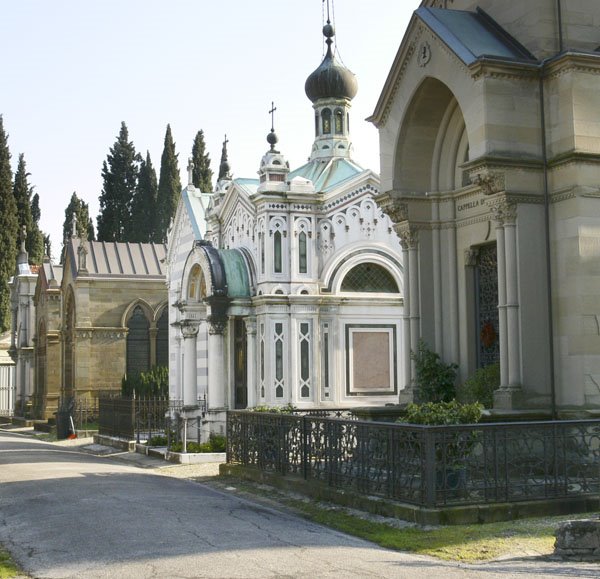
There is also a link with the past in yet another way, a link to and between the spirit of the living and the dead. In fact, there are Italian cemeteries such as Porte Sante and adjacent to the Basilica of San Miniato and Trespiano some four miles northwest of the city, which are linked to the famous Etruscan necropoli. Built more than 2500 years ago those Etruscan “cities of the dead” housed not just the remains and the spirits of their dead but also the spirit, the very essence of their culture, their world. Today as you stroll down “streets” of Porte Sante, flanked by “houses” made of stone and marble, in a variety of fantastic architectural styles, you cannot help but feel that you are a witness to a direct connection between what you are seeing and those “houses” of death which once lined the Appian Way, themselves a continuation of the Etruscan view toward the vitality of maintaining a life spirit after death.
And another thing that makes many Italian cemeteries like Porte Sante and Trespiano worth a stroll on a beautiful spring afternoon: there are no lines to stand in for these artworks. You can stand and take it all in at your own pace. Moreover, each piece of artwork comes with a very real human-interest story. There are the war heroes, the artists, the rich and the very rich, the one-time great noble families, the teachers, the visitors, they are all here and many wanted to leave a bit of themselves behind so that you, a passing stranger will know a least a small part of their story. So we find a bit of marble or stone chiseled, sculpted, created and placed in such a way as to help you understand who they were, those long-dead men, women and children.

Take Emma and Bianca Marchesini, two sisters, who both died very young sometime in the early 1870s; the older sister died first followed soon after by her little sister. The statue shows the older sister veiled and standing behind the cross on her grave looking down at her younger sister who is running toward her with her arms outstretched.
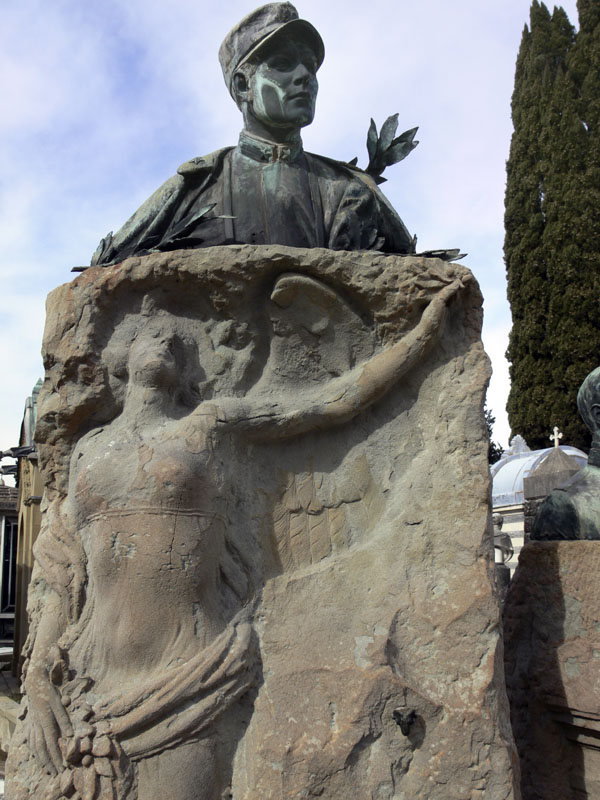
Or the Sembranti brothers, both of whom died during the First World War while fighting for their country. The surviving family wanted you to know just what their sacrifice was all about and the statues represent them in their uniforms with the bust of Ubaldini resting atop a female figure representing perhaps Italy, the motherland.
Then there’s the Cappella Lorenzini. Known simply by his village name “Collodi”, Carlo Lorenzini is known by children and parents around the world as the creator of that little wooden puppet, Pinocchio. His little chapel is still filled with fresh flowers. And there’s the small bust of Pellegrino Artusi, the father of Italian cookbooks.
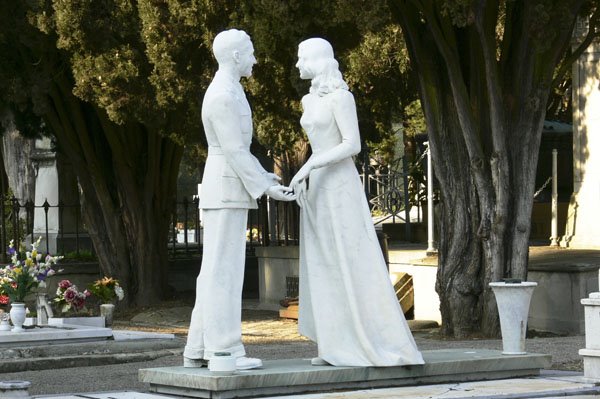
And then there’s Mario and Maria Mazzone. The life-size statues of these two young people who died so very long ago make even the most casual observer stop and look for details of this “love” story. One sees a young man in an airman’s uniform with a broad smile on his face looking squarely at the young woman whose gaze is turned slightly aside, and downward, with just a hint of a smile on her face, their hands just about to touch. One looks closely and reads in the inscription that Mario, born in 1919, was killed in Hamm, Germany on 22 April 1944; Maria, born in 1922, died some 11 months later, in May of 1945. No other Mazzones are buried there nor are there any clues as to who these people were? Were they lovers, husband and wife, what? And what was Mario doing in Germany some 10 months after Italy switched sides? Was he killed during the US bombing raid on Hamm on 22 April? And what about Maria? Did she die of a broken heart? In fact, according to Graziella Cirri, who has done an exhaustive analysis of the sculpture in several Florentine cemeteries, Maria and Mario were in fact brother and sister and the statue was commissioned in 1947 by their mother.
There are 17 cemeteries operated by the city of Florence, not including those burial grounds which are generally closed to the public, or are privately owned and maintained, for example the Jewish cemetery on Viale Ariosto, the Misercordia cemetery on Via degli Artisti or of course the “English” cemetery on Piazzale Donatello, the final resting place for Elizabeth Barrett Browning. (See my blog entry on the English or Protestant cemetery as it’s also called, just scroll down to "Valentine's Day.") And of course these don’t include the most famous Florentine burials in the churches of Santa Croce and San Lorenzo.
My personal favorite is Porte Sante at San Miniato, in part because it overlooks the city of Florence and but largely because it has the largest outdoor collection of sculpture I've seen so far. (Via S. Salvatore al Monte 34).

As the first “city” cemetery, Trespiano was created in 1784 as a result of a new law prohibiting the burial of anyone inside the city walls – it was deemed too unhealthy. But according to one source only the bodies of the poor received burial in Trespiano while the wealthy continued to use the old cemeteries. Trespiano eventually became the city’s primary burial ground, however and remains so to the present day. (it is an enormous cemetery and although lacking the monumental flair of Porte Sante it does have a large burial ground for the “Garibaldini” as well as a huge “Potter’s field” and a large military section.)
In 1854 the cemetery of Porte Sante was created on the grounds adjacent to the Basilica of San Miniato and quickly became the burial location for the wealthy and well-known Florentines and indeed the monuments reflect both their wealth and status.
If you're interested you can see additional photos on Porte Sante and Trespiano.
An excellent guide to five cemeteries with unique sculpture is Guida ai cimiteri Comunali di Firenze, by Graziella Cirri, Firenze: Edizione Polistampa, 2003. Ms. Cirri analyzed the sculpture of San Felice a Ema, Settignano, Rifredi, Trespiano and Porte Sante at San Miniato. In Italian. With very handy maps and notations where each statue can be found.
Hours for Porte Sante and Trespiano as well as the other cemeteries operated by the comune are:
8.00 - 17.00 (1 October-31 March)
8.00 - 18.00 (1 April-30 September)
8.00/13.00 (Sundays and holidays)
Porte Sante is 20-minute walk from Piazza della Signoria; about half of it is uphill.
To get to Trespiano, take the no. 25 bus from Piazza San Marco, and get off at the cemetery bustop.
The Mazzone "love" story
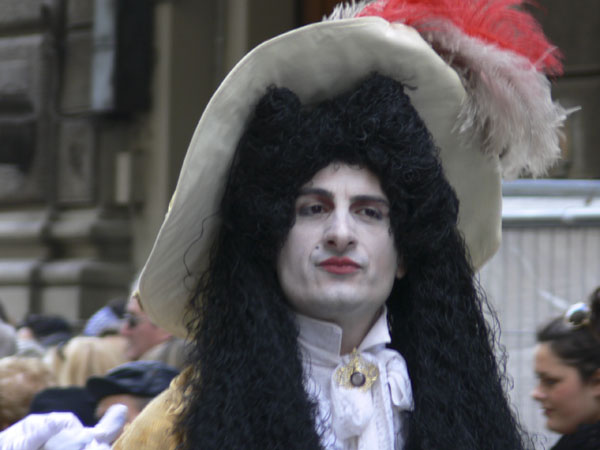
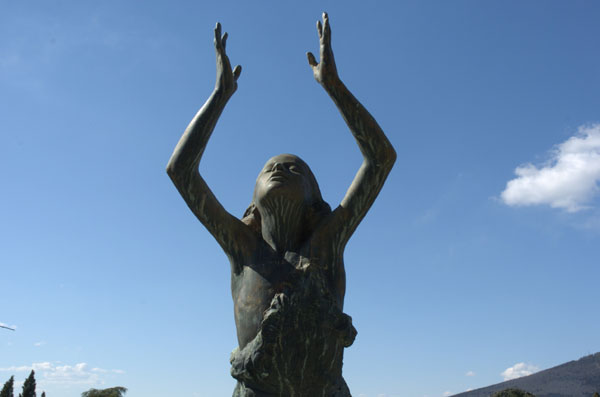
It’s been a pretty quiet week here for us: very calm and “molto tranquilo”. We hope your week has been the same. (Nope the photo has nothing to do with anything in the story; I took it during the Carnevale parade here in Florence and just wanted to share it with you.)
The weather has been on and off rain and sun and so we have just been cruising our neighborhood. Naturally Susan has been baking at home and we have been enjoying a variety of tasty items made with her homemade puff pastry – this afternoon for example she made little squares with brie and dried cherries on top and baked them as a sort of mid-afternoon snack. Tomorrow morning I’m counting on fresh-baked apple turnovers. . .
Aside from just enjoying being here we have really little new to report this week.
The “big” news – and it shows you how “small” our lives have gotten in the last few months – the big news is our last two boxes of “stuff arrived this past Tuesday, the very same day my camera was returned from the Nikon service center in Turin.
I suppose now that the games were over they could all get back to work there. But really I can’t say enough about Nikon or about their reps here in Italy. Shortly after we returned to Italy I discovered the camera’s focus was all haywire. After spending several frustrating days trying to find a repair shop in Florence I dropped the camera off at a local shop and it disappeared up north to the only Nikon repair center in Italy (presumably)– oh of course I did get a text message on my phone letting me know it arrived but other than that I had no idea what had happened to it. Anyway come to find out they had to replace the fleebus in the exposure dingis and they did all that for free – they didn’t even charge me shipping! Nikon rules!
But the boxes came as a surprise – we shipped three boxes via the US and Italian postal services on January 4 and one was waiting for us here when we moved to Florence the end of January. But where were the other two? No one had any idea. Everyone kept saying, “Don’t worry, they’ll show up someday”. And sure enough this past Tuesday they showed up – of course they had been opened, rifled through and resealed by the customs folks but everything was there. Whew. Now we can get on with our lives.
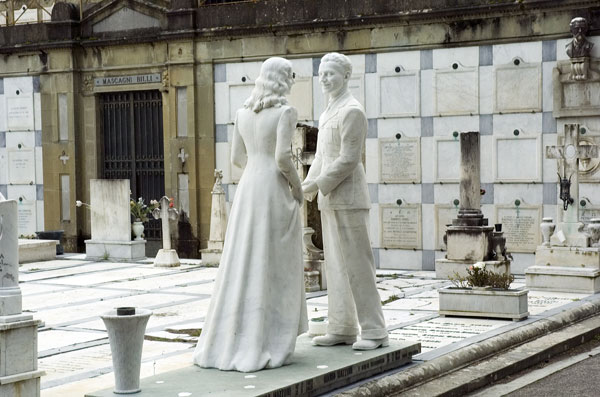
Now for an update on our "Mazzone love story". This concerns the statue of Maria and Mario Mazzone in the Delle Porte Sante cemetery and our Valentine’s Day “love” story. As you may recall right around Valentine’s Day we were strolling through the cemetery on a beautiful afternoon and came across this fascinating life-size statue of a young couple, Mario and Maria Mazzone. Mario is smiling broadly and looking directly at Maria; she on the other hand is looking off to the side and a bit downward but also with a hint of a smile on her face, and both are just about to touch hands. From the inscriptions we knew that Mario died in July of 1944 in Germany (presumably killed during an American bombing raid on that city although why he was there remains a mystery) and Maria passed away the following year. Other than that we had no idea what happened in the story.
Naturally we assumed that they were young lovers and probably just married before he was killed (Maria had been born in 1922 and Mario in 1919). Well after a bit of research I just learned today (Saturday) that Maria and Mario were in fact brother and sister! According to the guide to the cemeteries in Florence their mother arrange din 1947 for statue dedicated to these “due fratelli” or two siblings to be placed over their graves. Quite a story there I’d say.
Take care of yourselves and as always,
Wish you were here.
Steve
Subscribe to:
Posts (Atom)
Chihuly in the Japanese Garden
We returned to Meijer Gardens recently to finish off our tour of the Chihuly sculptures, this time focusing on the Japanese Garden. new take...

-
 The oldest child and oldest boy of Tunis VandenBerg and Bernice Van Halsema, William J VandenBerg 1950-2012. Photo taken in 1955 at 413 Oa...
 -
 Friday 30 January Another leisurely morning in Lisbon and our last full day in Portugal's capital will be spent seeing the city with a l...