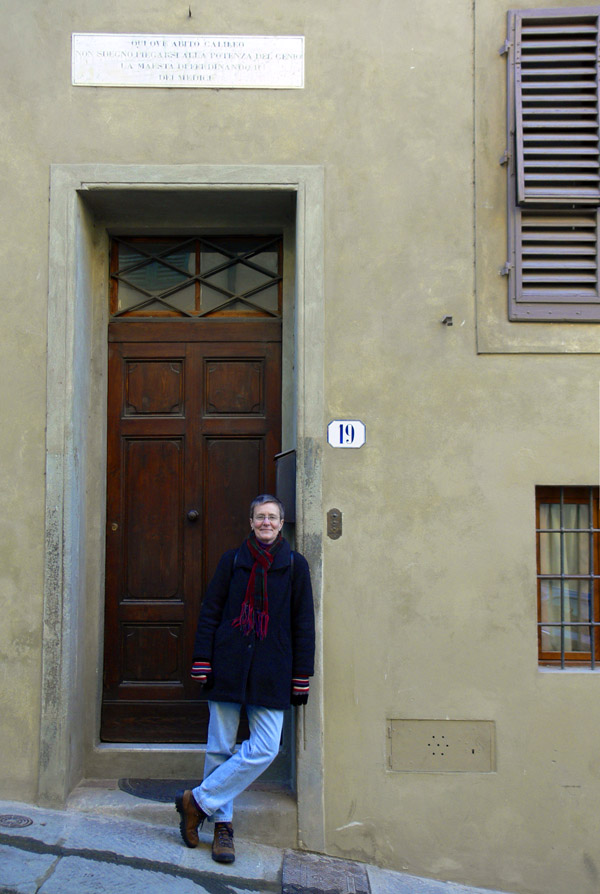
You meet the nicest people in a cemetery


OK so you’re asking, why write about cemeteries let alone visit them? I mean, that’s pretty morbid isn’t it?

Well I suppose in some parts of the world anything connected with death must be avoided at all costs; but in Italy there is not only great respect for the dead but there is a concrete link between the living and those who have passed on. This is evident, for example, in the sheer number of flowers, fresh and otherwise that constantly adorn Italian cemeteries.
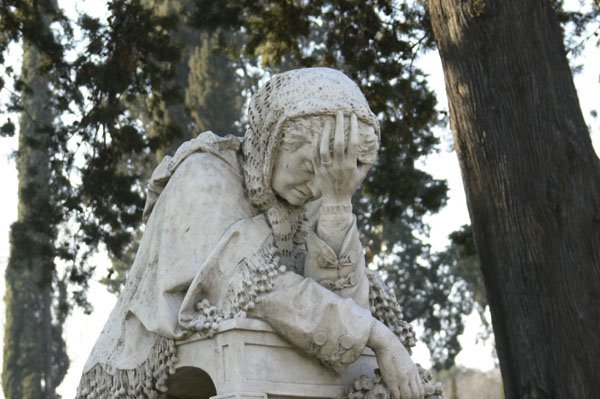
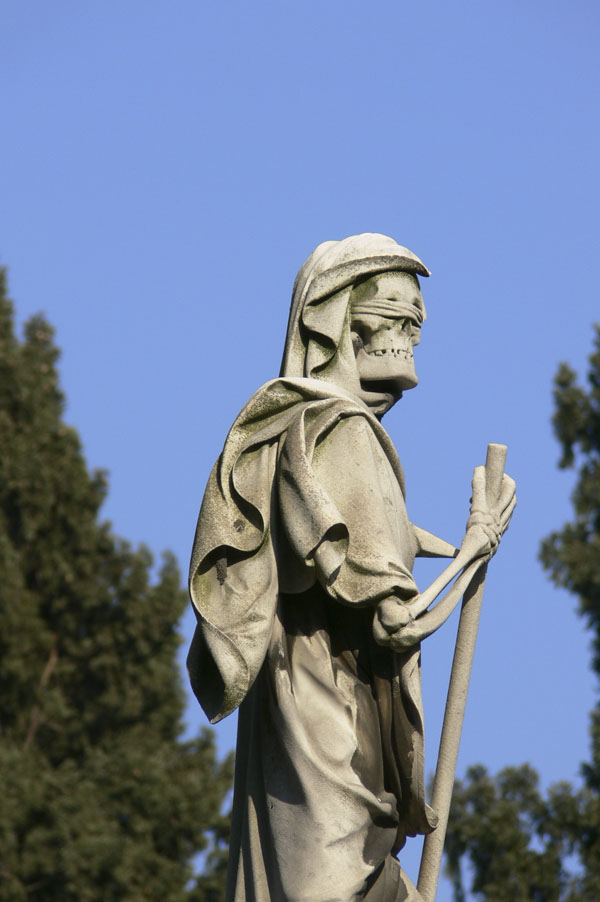
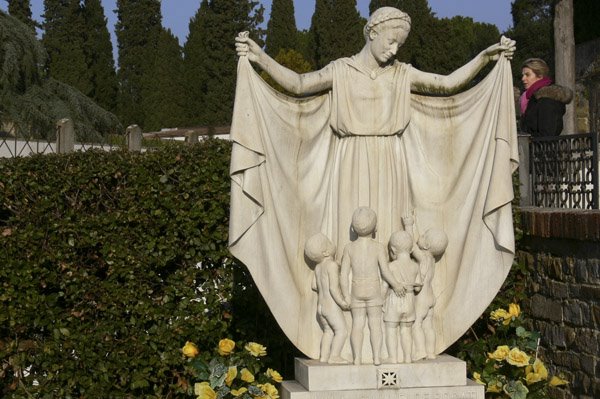
There seems to be a keen desire to share the memories of those who passed away, either through the use of photographs (very widespread) or, even more fascinating, through the use of sculpture to help the passer-by understand that this was a person of some fame, or a person who died young, or a person who was in love, or a person who died for the glory of his country or . . . well you get the point.
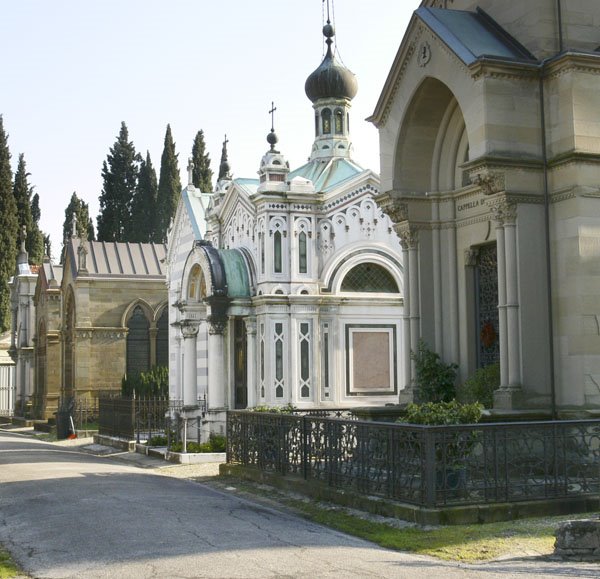


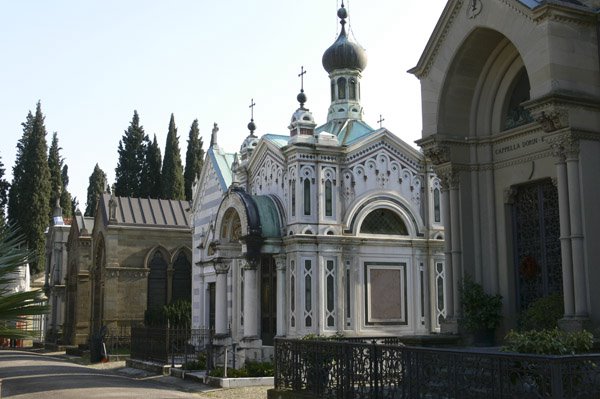
There is also a link with the past in yet another way, a link to and between the spirit of the living and the dead. In fact, there are Italian cemeteries such as Porte Sante and adjacent to the Basilica of San Miniato and Trespiano some four miles northwest of the city, which are linked to the famous Etruscan necropoli. Built more than 2500 years ago those Etruscan “cities of the dead” housed not just the remains and the spirits of their dead but also the spirit, the very essence of their culture, their world. Today as you stroll down “streets” of Porte Sante, flanked by “houses” made of stone and marble, in a variety of fantastic architectural styles, you cannot help but feel that you are a witness to a direct connection between what you are seeing and those “houses” of death which once lined the Appian Way, themselves a continuation of the Etruscan view toward the vitality of maintaining a life spirit after death.

And another thing that makes many Italian cemeteries like Porte Sante and Trespiano worth a stroll on a beautiful spring afternoon: there are no lines to stand in for these artworks. You can stand and take it all in at your own pace. Moreover, each piece of artwork comes with a very real human-interest story. There are the war heroes, the artists, the rich and the very rich, the one-time great noble families, the teachers, the visitors, they are all here and many wanted to leave a bit of themselves behind so that you, a passing stranger will know a least a small part of their story. So we find a bit of marble or stone chiseled, sculpted, created and placed in such a way as to help you understand who they were, those long-dead men, women and children.


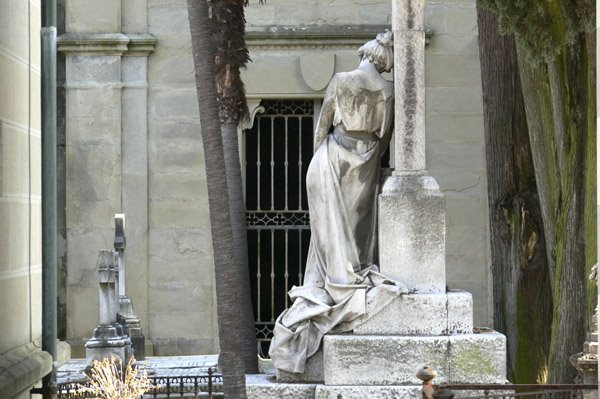
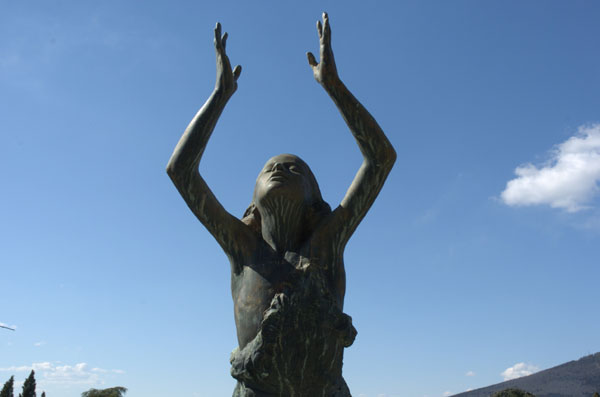
Take Emma and Bianca Marchesini, two sisters, who both died very young sometime in the early 1870s; the older sister died first followed soon after by her little sister. The statue shows the older sister veiled and standing behind the cross on her grave looking down at her younger sister who is running toward her with her arms outstretched.

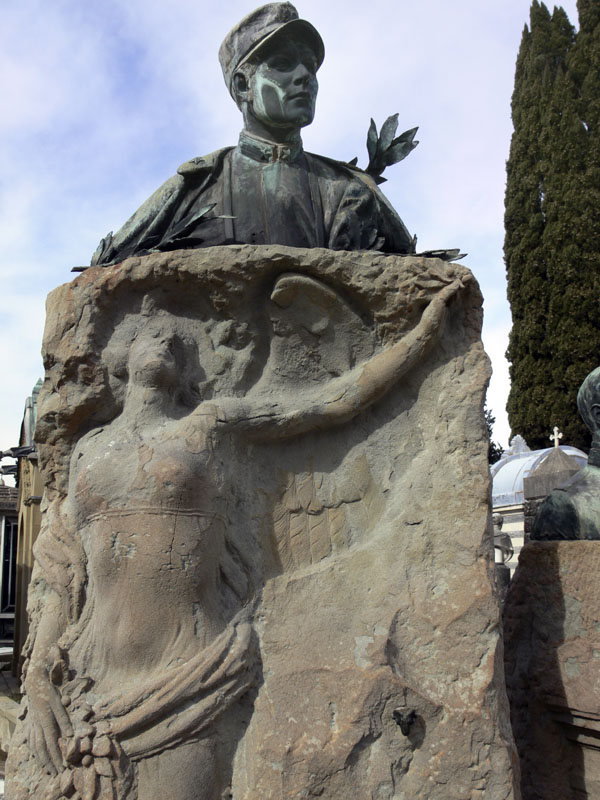
Or the Sembranti brothers, both of whom died during the First World War while fighting for their country. The surviving family wanted you to know just what their sacrifice was all about and the statues represent them in their uniforms with the bust of Ubaldini resting atop a female figure representing perhaps Italy, the motherland.
Then there’s the Cappella Lorenzini. Known simply by his village name “Collodi”, Carlo Lorenzini is known by children and parents around the world as the creator of that little wooden puppet, Pinocchio. His little chapel is still filled with fresh flowers. And there’s the small bust of Pellegrino Artusi, the father of Italian cookbooks.

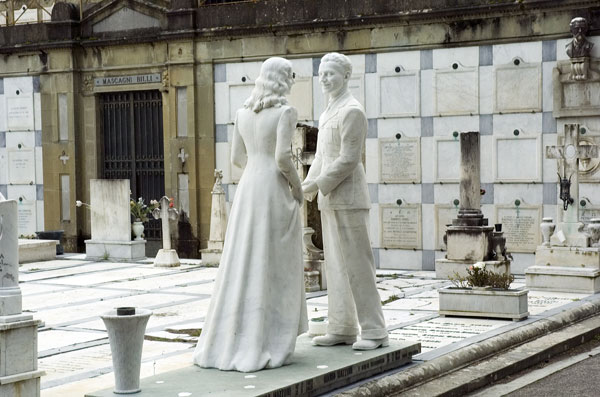
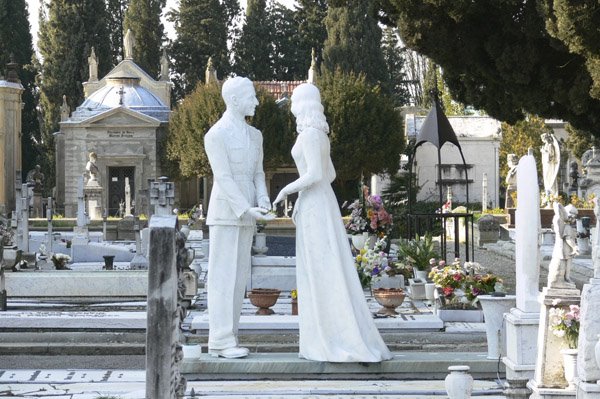
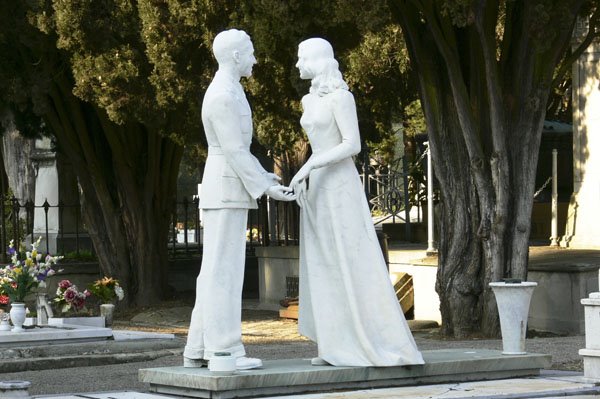
And then there’s Mario and Maria Mazzone. The life-size statues of these two young people who died so very long ago make even the most casual observer stop and look for details of this “love” story. One sees a young man in an airman’s uniform with a broad smile on his face looking squarely at the young woman whose gaze is turned slightly aside, and downward, with just a hint of a smile on her face, their hands just about to touch. One looks closely and reads in the inscription that Mario, born in 1919, was killed in Hamm, Germany on 22 April 1944; Maria, born in 1922, died some 11 months later, in May of 1945. No other Mazzones are buried there nor are there any clues as to who these people were? Were they lovers, husband and wife, what? And what was Mario doing in Germany some 10 months after Italy switched sides? Was he killed during the US bombing raid on Hamm on 22 April? And what about Maria? Did she die of a broken heart? In fact, according to Graziella Cirri, who has done an exhaustive analysis of the sculpture in several Florentine cemeteries, Maria and Mario were in fact brother and sister and the statue was commissioned in 1947 by their mother.
There are 17 cemeteries operated by the city of Florence, not including those burial grounds which are generally closed to the public, or are privately owned and maintained, for example the Jewish cemetery on Viale Ariosto, the Misercordia cemetery on Via degli Artisti or of course the “English” cemetery on Piazzale Donatello, the final resting place for Elizabeth Barrett Browning. (See my blog entry on the English or Protestant cemetery as it’s also called, just scroll down to "Valentine's Day.") And of course these don’t include the most famous Florentine burials in the churches of Santa Croce and San Lorenzo.

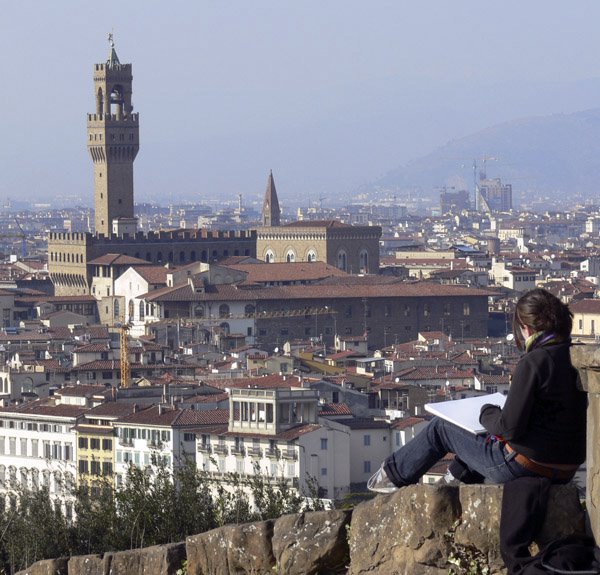
My personal favorite is Porte Sante at San Miniato, in part because it overlooks the city of Florence and but largely because it has the largest outdoor collection of sculpture I've seen so far. (Via S. Salvatore al Monte 34).


As the first “city” cemetery, Trespiano was created in 1784 as a result of a new law prohibiting the burial of anyone inside the city walls – it was deemed too unhealthy. But according to one source only the bodies of the poor received burial in Trespiano while the wealthy continued to use the old cemeteries. Trespiano eventually became the city’s primary burial ground, however and remains so to the present day. (it is an enormous cemetery and although lacking the monumental flair of Porte Sante it does have a large burial ground for the “Garibaldini” as well as a huge “Potter’s field” and a large military section.)

In 1854 the cemetery of Porte Sante was created on the grounds adjacent to the Basilica of San Miniato and quickly became the burial location for the wealthy and well-known Florentines and indeed the monuments reflect both their wealth and status.

If you're interested you can see additional photos on Porte Sante and Trespiano.

An excellent guide to five cemeteries with unique sculpture is Guida ai cimiteri Comunali di Firenze, by Graziella Cirri, Firenze: Edizione Polistampa, 2003. Ms. Cirri analyzed the sculpture of San Felice a Ema, Settignano, Rifredi, Trespiano and Porte Sante at San Miniato. In Italian. With very handy maps and notations where each statue can be found.

Hours for Porte Sante and Trespiano as well as the other cemeteries operated by the comune are:

8.00 - 17.00 (1 October-31 March)
8.00 - 18.00 (1 April-30 September)
8.00/13.00 (Sundays and holidays)

Porte Sante is 20-minute walk from Piazza della Signoria; about half of it is uphill.

To get to Trespiano, take the no. 25 bus from Piazza San Marco, and get off at the cemetery bustop.
The Mazzone "love" story


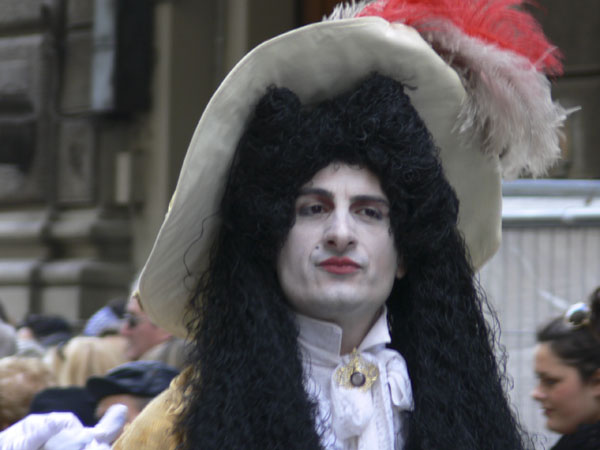
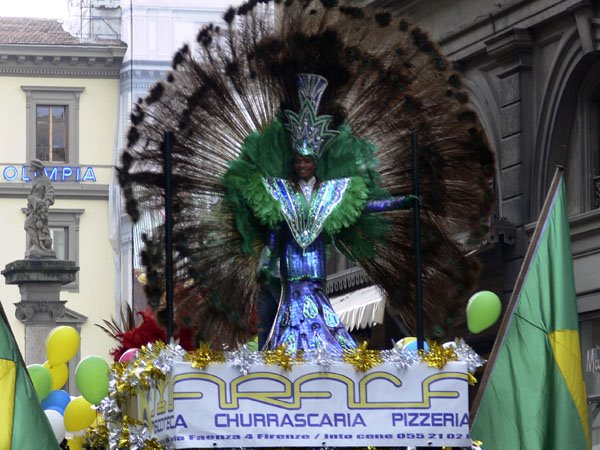
It’s been a pretty quiet week here for us: very calm and “molto tranquilo”. We hope your week has been the same. (Nope the photo has nothing to do with anything in the story; I took it during the Carnevale parade here in Florence and just wanted to share it with you.)

The weather has been on and off rain and sun and so we have just been cruising our neighborhood. Naturally Susan has been baking at home and we have been enjoying a variety of tasty items made with her homemade puff pastry – this afternoon for example she made little squares with brie and dried cherries on top and baked them as a sort of mid-afternoon snack. Tomorrow morning I’m counting on fresh-baked apple turnovers. . .

Aside from just enjoying being here we have really little new to report this week.

The “big” news – and it shows you how “small” our lives have gotten in the last few months – the big news is our last two boxes of “stuff arrived this past Tuesday, the very same day my camera was returned from the Nikon service center in Turin.

I suppose now that the games were over they could all get back to work there. But really I can’t say enough about Nikon or about their reps here in Italy. Shortly after we returned to Italy I discovered the camera’s focus was all haywire. After spending several frustrating days trying to find a repair shop in Florence I dropped the camera off at a local shop and it disappeared up north to the only Nikon repair center in Italy (presumably)– oh of course I did get a text message on my phone letting me know it arrived but other than that I had no idea what had happened to it. Anyway come to find out they had to replace the fleebus in the exposure dingis and they did all that for free – they didn’t even charge me shipping! Nikon rules!

But the boxes came as a surprise – we shipped three boxes via the US and Italian postal services on January 4 and one was waiting for us here when we moved to Florence the end of January. But where were the other two? No one had any idea. Everyone kept saying, “Don’t worry, they’ll show up someday”. And sure enough this past Tuesday they showed up – of course they had been opened, rifled through and resealed by the customs folks but everything was there. Whew. Now we can get on with our lives.


Now for an update on our "Mazzone love story". This concerns the statue of Maria and Mario Mazzone in the Delle Porte Sante cemetery and our Valentine’s Day “love” story. As you may recall right around Valentine’s Day we were strolling through the cemetery on a beautiful afternoon and came across this fascinating life-size statue of a young couple, Mario and Maria Mazzone. Mario is smiling broadly and looking directly at Maria; she on the other hand is looking off to the side and a bit downward but also with a hint of a smile on her face, and both are just about to touch hands. From the inscriptions we knew that Mario died in July of 1944 in Germany (presumably killed during an American bombing raid on that city although why he was there remains a mystery) and Maria passed away the following year. Other than that we had no idea what happened in the story.

Naturally we assumed that they were young lovers and probably just married before he was killed (Maria had been born in 1922 and Mario in 1919). Well after a bit of research I just learned today (Saturday) that Maria and Mario were in fact brother and sister! According to the guide to the cemeteries in Florence their mother arrange din 1947 for statue dedicated to these “due fratelli” or two siblings to be placed over their graves. Quite a story there I’d say.

Take care of yourselves and as always,

Wish you were here.

Steve

Carnevale!


Not to be outdone by either Rio di Janeiro or Mardi Gras in New Orleans or even by their neighbors in Venice or Viareggio on the Tuscan coast, Florence, too, has it’s “carnival” spirit, a spirit which was quite evident yesterday (Sunday) along the banks of the Arno river. (See my photos online)

Even though the day saw some off-and-on rain showers, Susan and I nevertheless decided to brave the elements and in the early afternoon headed for Piazza Ognisanti, located on the north bank of the Arno river.

The parade (“corteo”) consisted of various local ethnic groups and their respective associations, and kicked off at about 2:30 pm. It wended its way toward the Duomo and then end up in the Piazza Signoria, the very heart of Renaissance Florence. The “floats” were in fact large trucks decorated with the colors, flags and banners of the numerous ethnic groups which have settled in Florence: Ivory Coast, Peru, Albania, Greece, Chinese.

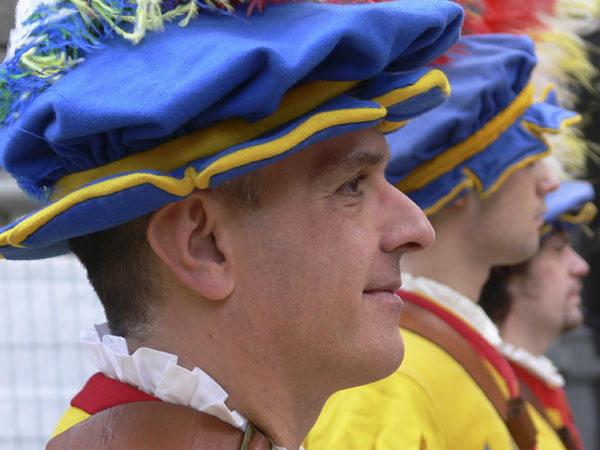
The parade was led off by a number of locals (presumably) dressed in Renaissance-era Florentine costumes. It was controlled chaos, in typical Italian style: Susan and I found ourselves, like a few others, walking alongside the “floats” as they began their movement forward and we are continually amazed at how relaxed the whole day was, given the large crowds.

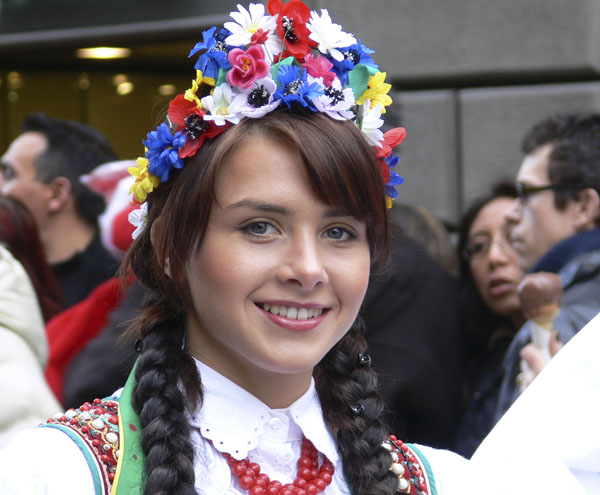
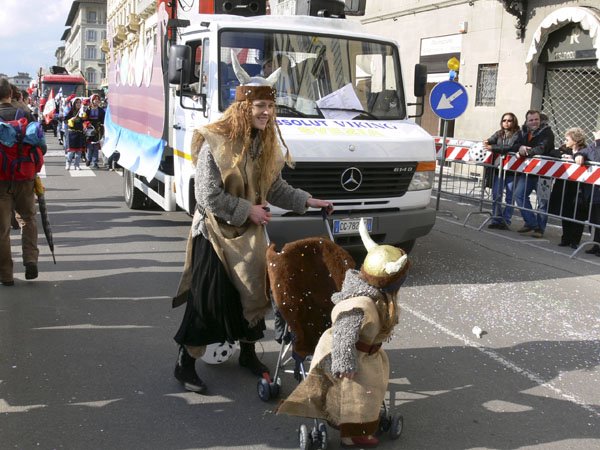
Apparently one of the ideas behind this whole affair was to get kids out with their families – and indeed there were many kids and parents (and grandparents) fully decked out in a wild variety of costumes, witches (“streghe”), Disney characters, mice (“topi”) and even the little Zorro we saw had a moustache and goatee neatly drawn on his face. And there were even a couple of Goths – or Vandals we couldn’t tell which – who were fully decked out along with their mom and baby brother -- or sister!

We spent the better part of the afternoon watching the parade from various spots, along the parade route and enjoyed the variety of ethnic music, singing and dancing by many of the participants. It was really great fun.

After we had pretty seen all of the “floats” we took a break and headed over to Paszkowski’s for a caffe. (The café is located right on the Piazza della Repubblica and so it was right next to the parade route which crossed through the piazza.) We also had the foresight to bring our umbrellas (“ombrelli”) with us because we got hit a couple of times with rain showers.


But those too passed and after watching some of the ceremonies on the Piazza Signoria, where all the “floats” had ended up, we headed back to the apartment for an evening at home: dinner followed by Columbo! That’s right we finally broke down and bout a little DVD player here and then went out and bought the first season of Columbo; a nice way to spend a chilly, rainy evening. And we were completely taken by surprise when the first episode finished and we saw that the writer was Steven Bochco and the director was Steven Spielberg!

And for dessert we finished off an apple/pastry cream tart which Susan had made the night before. This particular tart was the result of something novel she had learned in class: cooked pastry cream, which was then baked (along with the apples). And man oh man was this good or what!!? It was delicious Saturday night, Sunday morning and Sunday night!

We hope you are all well, warm and eager to enjoy life! As always,

Wish you were here,

Steve

Valentine's Day in Florence


OK, I know you've seent his one before but hey I like this photo. Oh the carousel? It's on the Piazza della Repubblica pretty much all the time. Another tiny historical note this was also the exact location of the original Roman city Florentia. Pretty cool.

Anyway, it rained Wednesday and Thursday and the temps have been a bit chilly without the sun but how far away can spring be now that February is half over?

Thursday we went to the movies at the Odeon (where they show the film in the original language) and saw Tea Leoni and Jim Carey in “Fun with Dick and Jane”; yeah it was fun but not much more than that. Afterwards we strolled, stopped and bought some wine, checked out a place called "Sam’s store", located on Via Ghibellina (the only place in town for All-American junk food and other sundry US items college kids can’t live without) and then stopped at Gilli’s on the Piazza della Repubblica for an aperitivi and light antipasti.

Anyway it wasn’t rainy for Valentine’s Day and in fact it was absolutely gorgeous here so we made the most of it. After a leisurely morning at home we walked over to the Accademia to see Michelangelo’s stunning and powerful David. After a stroll of about 45 seconds (it’s just around the corner) we walked in the nondescript entrance, paid our 13 euros, got our tickets -- there were absolutely no lines and so making a reservation the day before was completely unnecessary – and headed inside.

Before moving toward the gallery where the David is actually located we turned right from the entrance into the museum of musical instruments. They had a wonderful display of a history (of sorts) of musical instruments – with several computers set up for listening and as interactive information stations. There were several instruments by Stradivari and other Cremona, Italy instrument makers and a very nice exhibition, well homage really, to Bartolomeo Cristofori, generally regarded as the creator of the piano.

We then retraced our footsteps and soon found ourselves at the entrance to the enormous gallery, on either side of which were the four “prisoners”, four works of stone which remain unfinished and all the more powerful as a consequence; at the other end of which was the David, a mass of marble which seemed to dominate everything around it. We walked up to this tribute to the intelligence of man overcoming the brutishness of this life, circled it slowly and found ourselves truly amazed that this was created by the hand of one man; no power tools, just two hands. Surrounding the stature, sitting on the floor were quite a few students making their drawings; looking a a few of these one is struck by how differently everyone sees the same thing. That too is amazing.

But I suppose Mike would be amused by it all – but given what little I know of his history I think he would want a piece of the ticket action naturalmente.

We moved into the plaster cast room and were awed by the large number of works which were carved by just a few of the 19th century Italian sculptors. Although these were copies, and while some were clearly symbolic, others seemed to try and represent the individual for whom the piece was made – whether to adorn a garden or serve as watch over their final resting place; also worth a look as well.


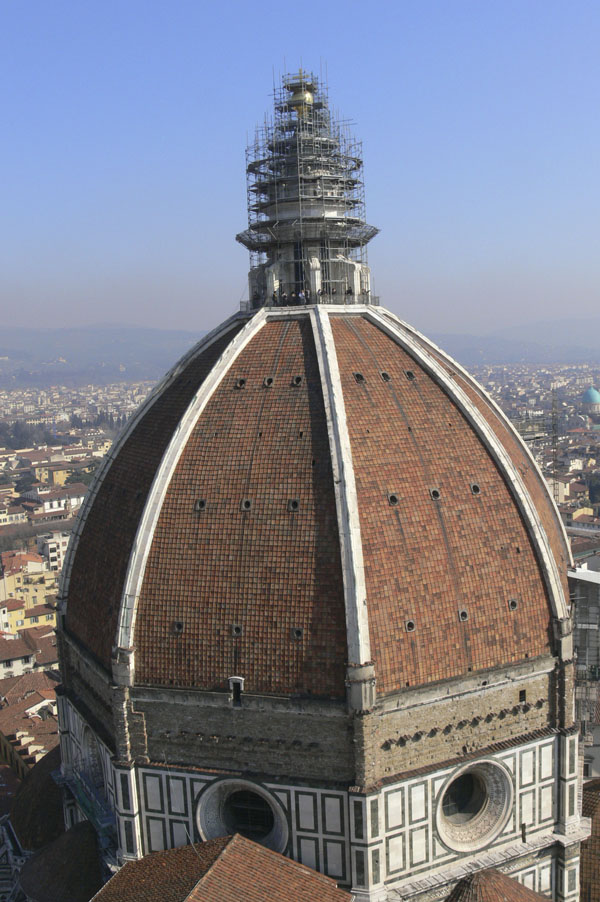
After leaving the Accademia we headed toward Giotto’s tower, the huge bell tower (“campanile”), which sits beside the Duomo in Florence. Originally designed by Giotto it was completed by Pisano and is about 83 meters high. So we paid our fee, and started our climb toward the top. After 414 steps and numerous landings where one had increasingly higher views of the city, including the Duomo itself (see photo)we arrived at the very top of the tower and what a great view it was. The day was a bit hazy but we had a spectacular view of the top of the Duomo.

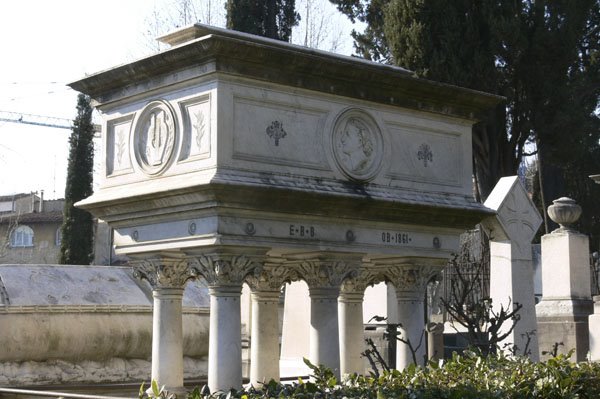
We stayed for a while and just took it all in – but we had to go eventually and go we did. Sue had class at 3:00 pm – Pastry Shop which is not to be confused with Wood shop for you Industrial Arts people – so after she went off to class I took my camera and walked north of our apartment about 10 minutes or so to the Piazzale Donatello, to find the “English” cemetery, the final resting place of Elizabeth Barrett Browning that's her just below).


Located right in the middle of one of Florence’s busiest thoroughfares, the “English”, or Protestant cemetery was originally outside the old city walls. After the walls came down Florence created a series of “ring” streets around the northern tier of the city, and Piazzale Donatello sits right in the middle between two of these, Viale Matteotti and Viale Gramsci.

Burials in the cemetery took place, often against the will of the majority of Florentines at the time, from 1827 to 1877 after which only cremated remains were permitted interment. While nominally called "English" the 1409 graves represent some 16 nations overall: 760 British, 433 Swiss, 87 North Americans, 84 Italians and 54 Russians are among those buried in the cemetery.


Although the cemetery is owned by the Evangelical Reformed Swiss Church, and administered by their "consistory", the property is managed and lovingly cared for by Julia Holloway and her staff, who live right on the premises. They not only oversee this wonderful little garden of powerful and evocative sculpture located right in the middle of one of Florence's busiest thoroughfares, but they also have put together quite a significant library of Browning materials as well. Julia a lively and very erudite English nun and speaking with her for the better part of an hour about the people who now rest in her care was a sheer pleasure.


Unfortunately, the small hillock on which the tombs rest is literally eroding away and much of the stones and sculptures are themselves turning from marble to gesso. They need help but they are not going to get it from the Italian government, local or national and the church is increasingly strapped for money. The question remains how much longer this island of Victorian history will remain.

After I left the cemetery I walked back to the apartment, dropped the camera off and went to pick up Sue at school (why to carry her books home of course).

We then went out later in the early evening for passegiata, and stopped at not one but two places to check out their prosecco selection and try their antipasti (it was Valentine’s Day after all). About 8:00 pm set out for Osteria Ortolano, which as some of you may recall is one of our favorite places to pick up wine and food to go (they really don’t serve there) and that’s what we did. About a week or so earlier we noticed they had put out a menu of a special dinner to take home (“portare via”) and we put our name down. It was sort of like going out but, sorta not, actually the best of both worlds we thought. For 32 euros (not including wine which was a sparkling Franciacorta, “Ca’ del Bosco”) we got the following:

For antipasto -- eggplant with parmigiana cheese in a multi-layered puff pastry;

For first course – pasta rosettes (wide pasta rolled and cut and then laid on its side to resemble a rose petal) with a ragu sauce; and also risotto with morel mushrooms and pecorino cheese;

For second course – slices of roast pork stuffed with celery and herbs and carrots, with glazed carrots; and slices of rabbit over a bed of stewed fennel;

For dessert – tiramisu and a glass of vin santo.

Eveyrthing was made right on the premises. Marta and Massimo, who run the Osteria both trained at the Cordon Bleu in France and this meal really showed off their culinary skills better than anything we’ve had so far (and so far it’s been pretty good).

Stay well, keep cool

Wish you were here,

Steve

A stroll in the park


This past week has been both a busy and yet relaxing seven days. The weather continues to be wonderful (sorry you Northeasterners) with sunny days, clear nights, with temperatures on the chilly side but perfect for urban trekking. (You can see find photos of this day’s outing online – just click here.)

Susan’s school is going well (see the entry “School days” for her observations after the first two weeks in class) and we have begun exploring more of Florence. Monday through Thursday are pretty routine, going to the market, (Susan) going to school, and just hanging out in our neighborhood, exploring some of the nearby side streets, that sort of thing.

On Friday, however, with Susan not having to go to school everything shifts into a different gear altogether. This past Friday was another gorgeous day, sunny although a bit chilly in the shade when we walked a couple of blocks over to the Museum of San Marco, located next to, surprise, the church of San Marco and just off, you got it, the Piazza San Marco, and spent the morning viewing the paintings of Fra Angelico.

A Dominican friar, Guido di Pietro, better known in the West as Fra Angelico, painted some of the most gorgeous work during the late medieval, early Renaissance period. Or in the words of one art critic: “His visages have an air of rapt suavity, devotional fervency and beaming esoteric consciousness, which is intensely attractive to some minds and realizes beyond rivalry a particular ideal—that of ecclesiastical saintliness and detachment from secular fret and turmoil.” (From the Wikipedia.)

I guess that says it all for me. I mean I often feel detached from “secular fret” myself.

After viewing Fra Angelico’s work – along with works by some of the other lesser-known friars who came and went through San Marco monastery we then went upstairs to view the former cells of the monks, and one in particular, Girolamo Savonarola. A sworn enemy of the Medici’s and a driving force behind urging Florence to expel the Medicis from the city in order to institute a more socially responsible government, the Dominican priest Savonarola let extremism get the best of him, and he was eventually hanged on the Piazza Signoria and his body burnt and ashes thrown into the Arno. Today you can see the spot where a plaque commemorates the site of the execution in the Piazza Signoria -- just look for a large group of tourists all standing in a circle looking down, rather than up at the statues.

In the afternoon we took our guidebook (Florence: Guide for the curious traveller, pubhttp://www.blogger.com/img/gl.link.giflished by Mandragora) and set out for the Piazzale Michelangelo, located just southeast of the city. Our objectives were to be out in the sun, to walk some of the side streets of the “Oltrarno”, the city south of the Arno, and get some great views of the city. Well we did that but we found much more along the way.


We crossed the Arno at the Ponte Vecchio (“old bridge”, but also loosely translated from the Italian as “big money”). In 1593 the bridge became the sole province of the goldsmiths (it had been previously occupied by butchers so I guess little really changed) and it has remained so ever since.

In fact one of the city’s most famous goldsmiths was the sculptor Benvenuto Cellini and his bust sits midway across the bridge. However, the city government has recently placed a metal fence around the bust. This reportedly is designed to prevent the continuing fad of lovers locking padlocks with their names scratched on them onto the small wrought iron fence around the statue and then of course they throw the key into the river, signifying their undying love I suppose.

So after we crossed the Arno we turned east heading upriver and after a short while turned south away from the river and began our climb up toward Piazzale Michelangelo, a steep but fascinating hike through small gardens walking on a series of steps called the Via di Crocis (“street of the crosses”) created by a group of Fransiscan monks from the church of San Salvatore, which is at the top of the hill just behind the Piazzale. And yes there were small wooden crosses, each about 5 feet high lining the entire path.


At last we arrived at the Piazzale and spent some time taking in the stunning views of the city.

We then turned away from the city and walked to the church of San Salvatore al Monte and then over to the nearby the church of San Miniato al Monte, all located, as their names suggest a the hill which overlooks the city. (While we can only take one museum of Madonnas a day we can handle at least several churches daily.)

We wandered down a path and from San Salvatore and couldn’t quite see the next church through the trees so we stopped a friar walking down the street and ask directions: “dov’e la Chiesa San Miniato?” He pointed toward the trees ahead of us and said “dietro” (behind). So we walked 100 meters or so through the woods – in fact through a “garden of remembrance” to men and women from the Italian Red Cross who perished in World Wars One and Two. The garden was filled with cypress tress, each bearing a small plague with the name of one of the fallen volunteers. We continued our walk up a small rise, through a gate and into an enormous cemetery (“cimitero”).


Now most guidebooks rarely bring up cemeteries as a place to visit. That is unless, one can identify particular celebrities, or famous persons who might be buried there, such as in the Protestant cemetery in Rome or Arlington National Cemetery in Washington, DC. Anyway few guidebooks on Florence mention the Delle Porte Sante cemetery (laid out in 1854) in other than passing fashion. This is really quite a shame since this particular place is an absolutely fantastic outdoor sculpture garden. Among the people buried there is Carlo Collodi, the guy who created Pinocchio.


But it is much, much more than just sculpture. Wandering among the stones you can see profound sentimentality, tragic love and nostalgia.

You might also get a hint at what the tombs were like which once lined the Appian Way.


One can also get a sense for the strength of feeling Florentine society has for its very personal history, a history written in the lives and loves and deaths of its citizens, mostly unknown men, women and children, who went about their daily lives doing what our species has always done, simply trying to enjoy life for as long as possible.


In the Capitoline museum in Rome is a room filled with the busts of nameless Romans, but with faces that betray their connections with the rest of us: fat, thin, worrisome, happy, smiling, all very lifelike in their portrayal of the subject. So too in Delle Porte Sante: busts of men and women striving to depict in stone the deceased as he or she hoped to be remembered.

Each stone tells a tale, a story as interesting as anything found in the Decameron by Giovanni Boccaccio. One example of just such a story is the love affair of Maria and Mario Mazzone.


Maria Grazia Collela was born in 12 February, 1922, and Mario Mazzone was born 28 November, 1919, and sometime during the Second World War they were married, possibly in Florence. Mario was a radio operator in the Regia Aeronautica (the Italian Air force), and died on 22 July, 1944, in or near Hamm, Germany. In September of 1943 the Italians ousted Mussolini from power and switched sides, joining the Allies in their war against Germany and Japan. So why was Mario in Hamm, Germany, some ten months later? Was he one of the units that remained loyal to the Germans? Or was he one of the many Italians taken as POWS by the Germans when Italy switched sides? We do know that on the day Mario died a group of U.S. B-24 bombers struck the rail yards at Hamm, Germany, inflicting serious damage. Was he killed during that raid?

And his widow? Maria died on 31 May, 1945, barely ten months after Mario’s death.


In a cemetery filled with sculpture, and with busts of the long departed, this life-size pair of statues is truly unique. But who arranged for the statues to be placed in the cemetery? Can it be assumed that both husband and wife were reunited in this one spot for eternity?

One thing is for certain: they will forever be young and in love, smiling, and happy.

We then went into the church and were immediately struck by its unique layout and interior décor: it was on three levels, each easily seen and readily accessible from either side of the church. (To see photos of the church – not mine by the way – click here.) And they were also tuning the huge organ in the church, which added to the atmosphere.


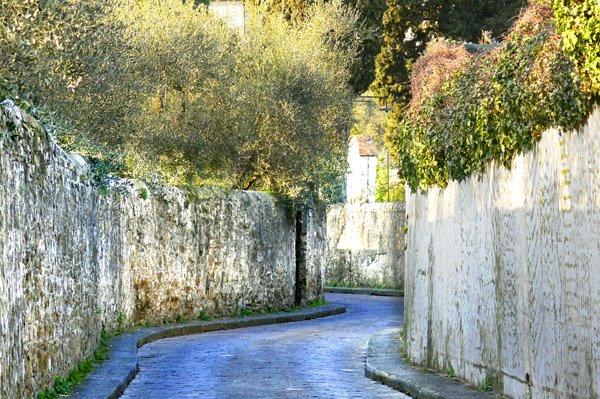
After we left the church we continued our stroll through the lovely park-like atmosphere on the hills overlooking Florence. We then turned down Via San Leonardo, a wonderful little surprise, a narrow curving road, which eventually led us back inside the city.


Just before we returned to the banks of the Arno we passed by the house of Galileo. Odd to think of what things these streets have seen and heard over the last several centuries -- what will they hear and see in centuries to come I wonder?

A wonderful day to be alive.

Wish you were here.

Ciao,

Steve

Chihuly in the Japanese Garden

We returned to Meijer Gardens recently to finish off our tour of the Chihuly sculptures, this time focusing on the Japanese Garden. new take...