Dreyfus


Friday afternoon was a pleasant day here in Paris. Susan had some chores to do and late in the morning I headed out to Pere Lachaise to get in a few hours of shooting. (Man I wish I had a euro for every time someone approaches me and asks where Jim Morrison is buried -- talk about globalization!)

Anyway Susan and I linked up later in the afternoon, meeting at the metro stop next to the Pompidou Center, and then walked a block down to the Rue du Temple and turned into the Museum of Jewish Art and History.

Ever since we arrived in Paris the first of August we had planned to see the Museum’s Dreyfus exhibition: “The fight for Justice.” Since it was extended to October 22, naturally we procrastinated but at last we got there. (photo: statue of Dreyfus, in the courtyard of the Museum of Jewish Art and History.)

We paid our admission, picked up our audio guides and headed into the museum. This place is really a stop worth making. The museum is a fascinating exploration into the Jewish experience in France told chronologically using a wonderful array of artifacts, paintings and photographs. Along the way one can get a full sense of France’s ambivalence to its Jewish population over the centuries, an attitude never more apparent than in the Dreyfus affair in the 1890s; and sadder still in France’s even shabbier treatment of the Jews during the Nazi occupation. The exhibition itself is mostly in French – although there is some very good interpretative signage in English. It would be of some help if you came prepared but the care and attention to detail in the layout and sheer volume of visual materials facilitates ease of understanding. This was one very moving and powerful exhibition.

After we left the museum we headed home, stopping to pick up some fresh bread for dinner along the way and called it a day. It was time for champagne! And why not?! I can’t believe how much different champagne there is here, everywhere – and all of it very inexpensive. Anyway, a few weeks back I discovered “Fontaines”, a little family place on the Rue Mouffetard crammed with bottles of wine, where they only buy from producers they know – and believe me these people know their wines. This evening we had a delicious sparkler from Wanner-Bouge. With frozen raspberries in the glasses it’s exactly what an aperitif should be.

Wish you were here,

Steve

Desserts, whither thou goest I shall go

OK let’s talk about why we’re here in the first place: desserts. And we’ve had plenty of ‘em over the past several weeks, compliments of Susie the pastry student and Le Cordon Bleu.

Let’s start with the "Jamaique", a chocolate sponge cake with pineapple-coconut mousse and a mango-passion fruit mousse, from September 5:


And on September 6, a "Fraisier" (sponge cake with strawberries and pastry-butter creme):


And on September 11, Susan's first "Opera " cake (sponge cake with chocolate ganache and coffee-butter creme):


And then we had "Three-chocolate Bavarian creme" on September 14:


Followed by "Heavenly chocolate" (chocolate mousse and "dacquoise") on September 20:


And at the same time, just for something different, we had truffles and coffee-chocolate candies:


On September 27 we had "Plaisir" (Pleasure), sponge cake with vanilla and chooclate mousse:


And recently, on October 10, Raspberry-Passion fruit creme cake:


And on October 11, Walnut cake (sponge cake with caramel mousse):


Mind you these don't include the stuff Susan baked at home . . . Yeah! It's great to be married to a pastry chef, take my word for it! Man can this woman bake!

Anyway, we're taking a break from desserts and head off to the Loire valley Saturday morning for an overnight -- a quick train trip to Amboise where Leonardo da Vinci is buried in fact. More about that later.

Wish you were here,

Steve

Food prices and the Paris Auto show


It’s a foggy Tuesday morning here in Paris as I sit here and try to catch up with the events of the past few days. Last week started out well but ended rather poorly. (All the more reason to start this entry with a smile. Thanks Total!)

On Tuesday I headed back to Chinatown to check out their meat and poultry prices (sounds like the excitement is just non-stop here in Paris doesn’t it?). One of the (major) disadvantages to living in Paris, like most big cities, is the cost of living is pretty steep compared to say living in the Sudan or Vermont. Meat is generally very high. For example, the butcher across the street sells pork tenderloins for as much as €15 per kilo (about $11 a pound) and boneless chicken breasts for about €12 a kilo ($8 bucks a pound). In Chinatown however a sense of normalcy reigns over the meat counter: boneless chicken breasts sell for about $3 a pound and the same for turkey and pork tenderloin! Other meats follow suit. Vegetables and fruit are wild cards pricewise and you really have to spend time looking not only for good prices but good quality as well. But shopping at the large Chinese supermarkets (such as the Tang Bros.) not only provides you with access to hard-to-find specialty food and produce items but they are always running serious discounts on fresh items: lately it’s been huge heads of cauliflower for €1 each! Or about 50-150% less than elsewhere!

Plus we also found a place that caters to Asian-themed bars and restaurants, selling all sorts of supplies, dishware, cooking utensils, etc. and so we now go there for things such as napkins and such.

Chinatown is really quite a misnomer since there are many Vietnamese-oriented stores and shops as well Asian restaurants: Japanese, Thai, Chinese, and Vietnamese, all catering to a substantial Asian community along Avenue d’Ivry in the 13th arrondisement. For us it is an easy 20-minute walk before we get to Chinatown, just on the south side of Place d’Italie or we can hop on the no. 7 metro and get off at Porte d’Ivry and walk a block up to Avenue d’Ivry and we are right in the heart of things. There is even a huge store which carries just frozen Asian foods!

So naturally I had to go back there the end of the week – and this time Susan tagged along. We took the metro on Saturday afternoon. I wanted to show her the restaurant supply place and just let her feel the sense of the energy of the place; I mean everybody seemed to be shopping for the weekend. And of course we had to skirt the tour group huddled curbside across from the Tang Bros. As the guide yammered on about something the tourists looked at amazement and nodded their heads in unison, as if they had never seen either Asians or streets or buildings or all of the above together. Who knows?

Otherwise the week went quietly for us. Susan attended class and signed up for another 2 weeks of French lessons at Alliance Française. Beginning Monday morning she’ll do three mornings a week, 3 hours each morning. I will forgo taking French. I’ve resigned myself to the fact that I will never really get this language – I never got Algebra either and have lived comfortably with that reality for many years now. And so it will be for French. I still work at speaking it whenever I can but as for lessons, no thanks, I’d rather take trigonometry.

Friday afternoon I met Susan at school and the plan was to jump on the no. 12 right at Vaugirard near school and go a couple of stops down to the huge Paris exposition center at Porte de Versailles to see the Paris Auto Show. (In fact it we walked down a stop and then hopped on the 12 at Convention, going just one stop farther.)

Neither of us had ever been to a major auto show before and this was pretty mind-boggling. The show covered some 7 or 8 different “halls” or exhibition buildings, of varying sizes: some halls were devoted to accessories and others to the tech side of the automotive world. We found our way to the entrance, bought tickets and went inside Hall no. 1, which was by far and away the largest and focused solely on “private cars”, that is to say, well, just cars. Anyway, we no sooner walked into the building than what was the very first booth we ran into? That’s right! You guessed it1 The Mini booth! Serendipity!

We spent the next couple of hours wandering around looking at all the cars – most of them regular production models and we couldn’t help but wonder if there was some sort of discount available to people who ordered cars off the floor since we saw a lot of folks interacting with sales reps as if they were doing just that – maybe they were just inquiring about wheelbase or horsepower. I don’t know.

Of course in some booths, one sensed a real class struggle just beneath the surface. At nearly all the booths people would simply open the door of a car and get in and start playing with the controls, checking it out. At BMW, Audi, Citroen, Renault, even in most of the Mercedes cars people were jumping in and out, opening and closing, checking things out; just as you or I might do in the showroom. However, this was not true everywhere. At the Ferrari booth a select few individuals – and they know who they are -- were “browsing” the cars, sipping champagne, asking questions, presumably about how fast it would go in the 1/4 mile that sort of thing, whereas the rest of us would simply ask the most obvious question: “so how much does this baby cost?” Uh-huh. Not a question that will actually get you into the car to play with the knobs and such. But at least at booths like Ferrari and Aston Martin the cars were outside, on raised pedestals to be sure, but they were part of the “show”.


Not so the Maybach. The (one) car was in a glass-enclosed room and only a handful of “aristocratii scatti” were permitted to enter and actually touch the car. A pretty young woman in a plain print dress stood guard just inside the door and was in constant contact with the great Unwashed outside. She had a pleasant smile on face and kept the door cracked just enough so she could tell the people they couldn’t come in. As I stood there watching I imagined the conversation something like this:

Guy in t-shirt that says “ready to wear” says (in French): “Hey can I take a look at that car”

Pretty woman guarding door says (in French): “no you can’t come in here, it’s for special people only and, let’s face it you’re not one of them and never will be so get used to that fact right here and now and go look at the Dacia Logan or the little Renault Twingo because that’s what you are a Twingo! HAHAHAHAHAHAHA!”


Anyway it was cool to see the concept cars by Peugeot and Citroen (above) and Citroen had a pretty imaginative bit of mechanical “performance” art using a full-size model of one of the old Citroen sedans which made this remarkable transformation into some kind of “power transformer” all set to techno dance music. Cool.


We also saw the new Audi R8 (below), as well as solar-powered cars (not available in Texas or Saudi Arabia) and of course the Lamborghini booth. That was disappointing: very nice cars but boring colors! White? Gray? Lamboghini?! What industry design giant came up with that concept I wonder. And what’s with car wheels today? The ones on the Lamborginis had hardly any tire on them the wheels are so huge! Frankly that cannot be good. And on a car that goes in excess of 250 kms/hour – well it should be interesting.


Susan and I continued our wanderings around the various halls – stopping at one point to take a break and sip some white wine while we watched the ebb and flow of humanity sweeping across the floors of hall 5. Or was or 4? Or maybe 3.2.


In between halls we couldn’t help but notice one interesting thing: the French Foreign Legion had a substantial display booth set up, with men (and one woman I might add) handing out literature, amidst tents set up and mannequins dressed in various styles of Legion outfits and even a couple of tanks; one which was in use in France around 1935 and other, the FT17 from, well, 1917 and made by Renault (below). I wondered why it was here and not at the Renault booth. Anyway Susan and I stopped and picked a recruiting brochure wondering if they would take couples – the answer is they don’t, single folks only; oh and the maximum age is 40. So we’re back to square one.


And what is square one exactly? That’s what we’ve been trying to figure out. If you have the answer please drop us a line and let us know.

The weekend had promised to be a beehive of activity: Paris “nuit blanche” (white night) was scheduled for Saturday night and so we thought we might try and catch an open museum or two and have a late meal somewhere. We also planned to go to Versailles on Sunday. But late Friday night I caught a virus of some sort (probably from standing too close to the Maybach booth) and so we stayed in; Susan studied French and we watched episodes of Seinfeld on DVD compliments of Christina (our niece).

Then came the Big Blow. On Sunday I discovered that somehow, I deleted all my Pere Lachaise images – hundreds of photos I collected during some dozen or so days of work out there, had seemingly disappeared. How it happened is anyone’s guess, but I can only assume I inadvertently deleted them. (I doubt I did it advertently.)

Anyway I set about trying to recover the files. I went online, Googled my problem and after a couple of false starts with two other programs I downloaded a copy of Prosoft’s Data Rescue II. (I use their backup software. Which is funny of course since I didn’t back of those images. Huh-huh.) After several hours I was able to recover nearly 78 gigabytes of files from the external hard drive where the images had been stored but sad to say only a fraction of my Pere Lachaise images were recovered. I have duplicates of most of my image files but unfortunately not my cemetery collections; I simply do not have the hard drive space. I know, I know – buy more space. That’s the next step believe me. So a word to the wise out there: “ya got images, ya got important files, back ‘em up at least in two places.” And don’t do it on the cheap. Remember, “you get what you pay for.”

The one bright note is that I do have online copies of my “favorites” so I can now plot my return to the cemetery in a more systematic fashion. It’s back to Pere Lachaise as soon as the weather opens back up. And hey I wanted to go back anyway after the leaves were off and the light spread out so this may be a blessing in disguise, which is exactly how my mother-in-law would see this whole thing, right Mom?

Wish you were here,

Steve

PS Tuesday afternoon. I just came back from Pere Lachaise with a batch of some 350 images and have completed 8 out of 97 divisions.

Verdun


We left Germany late Sunday morning and had an easy drive back to France. It rained a bit but before long the sun was shining and we cruised right along the autobahn. We took a different way this time – missing Frankfurt altogether in fact. We headed west toward Wiesbaden, then around Mainz and were soon back in “Frankreich.” If we didn’t have to slow down going past the old customs booths we would hardly have noticed the border even existed. Even the signs informing you of passing from one country to another are small and quite inconspicuous. I wonder if North Americans couldn’t learn something here, but I doubt it. (photo: Ossuary on the battlefield.)

After a four hour drive we reached our Verdun turnoff – we decided to take a back road toward the town and so we cruised along the Lorraine countryside for some 20 kms or so before reaching this most historic of World War One cities, where we promptly got lost.


OK we weren’t lost per se – we knew where we were we just couldn’t find our hotel, the “Hostellerie du coq Hardi”. They had emailed us a map – apparently drawn by a drunk 6-year-old -- showing how to find the hotel, which was right in the historic city center and along the river. Of course they failed to tell us about the one-way streets or that we had to unload in one place and then drive to park somewhere else entirely. No, they didn’t. so naturally the result was we could not for the life of us see the hotel anywhere it was supposed to be (based on the map we had), and consequently we found ourselves going around and around and around in circles, crossing and recrossing the river Meuse several times. We decided enough was enough. So we stopped, parked and started walking the streets with our lousy little map. Rather than driving around aimlessly we were now walking in circles. We walked and walked, around and around, and when we stopped in a café to ask they pointed “over there” and so we went “over there” and saw nothing. Up and down the river we walked. And then came a revelation from on high: there was the hotel – a huge building with an even bigger sign on its roof: “du coq Hardi” with a flashing green arrow pointing to an enormous rooster. (photo above: the Verdun memorial in town and our hotel on the right; below: Meuse River passing through Verdun; our hotel is just to the right of the camera.)


As we checked in we learned that the hotel’s restaurant would be closed for the evening, it being Sunday, and indeed most of the town’s restaurants would be closed as well. Regarding the hotel, aside from their terrible directions, we can recommend it primarily for the location: virtually on the river and close to everything in the downtown area plus it is only a 10-minute drive to the battlefield. Our room was large, although the floors were creaky and tilted a bit. The bathroom was equally spacious but had that hand-held shower which I loathe but obviously others prefer – you know the one: where you squat in the tub like, well never mind what it’s like. So you squat and hose down and then hose off and out. There was small lift (2 persons maximum), one with that sliding metal screen door right out of a Hitchcock film. I kept looking for Jimmy Stewart to come tearing down the hall.

So we unpacked, refreshed ourselves and then got ready for the battlefield hike.

We had talked about maybe doing the hike on Monday before returning to the city – but it was still early in the day, the sun was out and seemed determined to stay that way and so we headed back out of town toward the Verdun battlefield.

For our brief tour of the battlefield we relied heavily on Christina Holstein’s Fort Douaumont: Verdun (the Battleground Europe series) for providing both the central details of the 10-month long battle in 1916 around Verdun, which cost hundreds of thousands of French and German lives, and a nicely laid out walking/driving tour. Her book is also useful for touring Fort Douaumont itself, where much of the original interior space is accessible today. But be forewarned: the tunnels are very damp, cold and plenty of water on the floor so wear the appropriate clothes, particularly footwear.

I cannot emphasize enough how important it is to have a good, easy-to-use guidebook here. The battleground covers so much physical space and walking is really the best way to see many places on the field. There is an excellent guide-map of the battlefield (in three languages) that is available in the Verdun memorial and museum bookshop near the destroyed village of Fleury. It sells for €10 and I should think an absolute necessity for the serious walker/hiker of the battlefield. (Most of the present battlefield park is owned by the state so walking and biking are rarely an issue.)

For online resources check out:

http://www.verdun-douaumont.com/en/index.html

http://www.ingrid-tourisme-verdun.com/


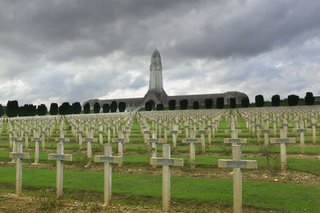
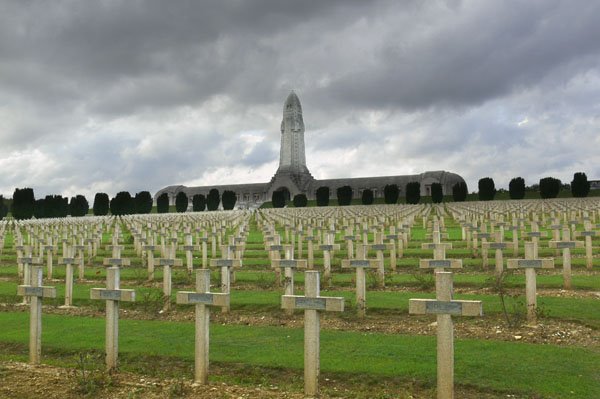
After leaving Verdun we climbed up from the valley floor to the nearby ridgeline toward the battlefield, giving an absolutely spectacular view of the Meuse valley and the town of Verdun. We drove past the Memorial de Verdun and the destroyed village of Fleury to the large car park next to the Ossuary and national cemetery. Officially inaugurated in 1932 the Ossuary contains the remains of some 130,000 French and German soldiers who fell at Verdun. At some 46 meters high the tower of the Ossuary is probably the most conspicuous land mark on the battlefield, and is placed in middle of a central gallery which runs for 137 meters, containing 42 alcoves where you can see the sarcophagi arranged according to which part of the battlefield the remains came from. The Ossuary looks quite like the hilt of a sword buried in the ground. You can climb to the top of the tower for a panorama of the battlefield, and there is also a bookshop on the lower level. (photo above: the Ossuary and National Cemetery.)

We left our car and after touring the Ossuary briefly we started walking along the road toward the village of Douaumont. (We were using Holstein’s suggested walking tour here.)


One of the first things you notice about the entire battlefield is the land, or rather the shape of the land – it is all lip-to-lip craters, like a lunar landscape but covered with trees, allowing one to get just a hint at what it looked like as more than 2 million shells pummeled the battlefield during the 10 months of fighting in 1916. (photos above: from the village of Fleury, one of the central parts of the battlefield -- picture it without the trees and green growth, just dirt, mud and the occasional stagnant water pool.)


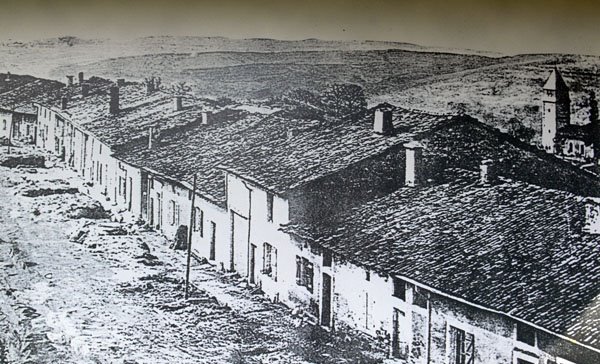
And there is no better place to see the impact than on the nine villages which were at one time on the site of the present battlefield. One of nine villages destroyed during the fighting in 1916, Douaumont, like the other eight, was never rebuilt, the handful of survivors moving elsewhere. (Although every October there is a memorial mass service held in the tiny chapel Douaumont, which was built over the remains of the original church.) The original buildings and homes of the village are all outlined with small white markers noting who lived there and what they did (plumber, winegrower, etc.). It’s very eerie actually, strolling down streets devoid of all signs of life except for those small markers in the ground hinting at the lives that had gone on here for centuries and that were snuffed out in such waves of destruction that it is virtually unimaginable today. (photo above: Douaumont village before 1916; below: Douaumont village, 2006.)


To find out more about the destroyed villages in Verdun, click here.

From Douaumont village we took a footpath across country toward Fort Douaumont, one of the central elements of the Verdun battlefield, some 800 meters away. Along the way through the undergrowth and trees one can really see the profound changes to the topography; as you climb toward the fort you have to maneuver around the constantly undulating ground and the pools of black, stagnant water. As you look through the forest around you the ground in fact appears to be massive green waves on an ocean frozen in a moment’s upheaval ready to crash down again at any minute. The word is that there are still plenty of unexploded devices out there. We didn’t stray off the path.(photo below: Susan standing next to a machine gun turret on the "roof" of Fort Douaumont, Verdun battlefield.)


We were brought back to the present as we stumbled into the car park next to the fort. We wandered around the exterior features, checking out the observation posts and the various gun turrets. The roof of the fort looks much like the surrounding terrain I might add since it was one of the featured targets during the months of shelling (first by the Germans taking it from the French and then by the French taking it back from the Germans.) We walked back to where we had started and found the entrance. We paid the entrance fee of €3 per person and walked into the main tunnel. (photo below: exterior of the fort today.)
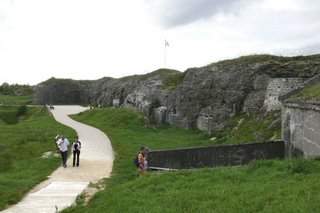

Unlike most forts we think of today the French fort system in the late 19th and early 20th century were actually underground complexes of tunnels, leading out from a complex of living areas and supply spaces to the machine gun turrets, observation posts and of course the big gun turrets, the 75mm and 155mm guns which were the central feature of these forts. (photo below: 75mm turret raised to firing position.)


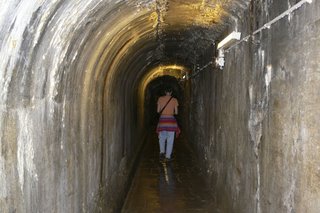
There are in fact several levels to the fort and you’re pretty much on your own in finding your way around. (photo above: one of the corridors inside the fort.) Fortunately the signage is good – and multilingual – so you can get a sense of the major features of the fort’s interior: the washroom, the barracks room, the kitchen, laundry, bakery and so on. You can even see the mechanical system involved in raising and lowering the big 155mm gun turret – the turrets were raised to fire and then lowered to protect the guns from artillery barrages. One of the most poignant features of the fort’s interior is the “German cemetery.” During the brief period of time that the Germans occupied the fort in 1916 there was explosion inside that killed more than 600 soliders who were trapped in the living areas. When rescuers tried to extricate the bodies they found the carnage so extensive that they simply sealed up the rooms, or rather casemates where the men had died and today there is a memorial at the bricked up wall.


From the fort we continued our walk back in the direction of the Ossuary, passing a couple of combat shelters as well as a communications trench from 1916:


After a brief walk we eventually ended up at the National Cemetery. Some 15,000 French soldiers are interred in the cemetery including a large number of Muslims (whose stones face east); there is also a large memorial in a mosque-like structure honoring the muslim troops for their part in the war.
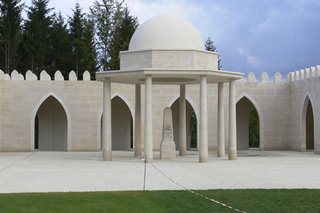

On the other side of the cemetery is a large memorial honoring the French Jewish soldiers who died at Verdun as well.

After returning to our car we drove to the nearby abandoned village of Fleury where we walked around for a bit, looking for insight as to what happened here. There were of course the markers delineating the homes and shops that had once been the village, but unlike at Douaumont, there were even signposts noting the streets that had once bustled with life and were now empty of everything except memories and the green growth of time.

From Fleury we stopped at the large memorial and museum a couple of hundred meters away – but since they were getting ready to close we only browsed the bookshop.

The shadows were lengthening but we still had some good sun left so we continued our drive around the battlefield visiting several other nearby sites before returning to the town of Verdun and our hotel.


In particular I wanted to stop at the "Tranchée des Baionettes", the trench of the bayonets, located about a 3-minute drive from the Ossuary. The story goes that between June 10 and June 12, 1916, the men of the French 137th regiment suffered intense bombardment by super-heavy German guns, including 280mm and 305mm howitzers. In 1919 when the former colonel returned to the battlefield he found the trench where a number of his men hadv apparently been buried alive as only their rifles (and supposedly their bayonets) protruded from the dirt. In 1920 the trench was excavated and some 47 bodies were found, 14 of which were identified. An American banker, George Rand, saw a photograph of the "trench" prior to its excavation and was so moved that he raised more than 500,000 francs to build the concrete memorial which today hovers directly above the trench. (photos above and below: memorial at the trench of the bayonets.)


As restaurant choices were slim for the evening, mainly lots of café types along the river, we ended up eating at a place just around the corner from our hotel as it turned out: “La Table de Alsatien” (the “Alsatian Table”). The food was good, service interesting and prices reasonable. Shortly after we sat down a man was seated at the table next to us. Later on John introduced himself – after hearing us speaking English – and it turns out he was from Texas and had been visiting in Germany but wanted to come to Verdun to tour the battlefield so here he was for a couple of nights; and staying at the same hotel! We chatted for a bit about Verdun sharing some of our thoughts about what we had seen during the day. He had arrived late so he hadn’t been able to get out to the field yet.

After saying goodnight to John and wishing him a successful trip to the battlefield Susan and I turned in for the evening.

We awoke to overcast skies, blustery winds and rainy weather. While we counted ourselves fortunate to have made our tour of the battlefield the day before, we felt a little sorry for John. As we checked out of the hotel I caught him eating his breakfast in the hotel dining room and wished him well and good luck.

We found our way back to the car park, loaded up and headed out of town and toward the A4 for Paris. Signage for getting to the A4 was good but took us forever to get out of town – or so it seemed to us anyway. But before long we were on our way humming down the “Voie Sacreé”, the “sacred way”, which is the highway that the French used to bring supplies from Bar-le-Duc to Verdun during the battle in 1916 and is memorialized today by a series of mile markers as well as a large memorial not far outside of the city. (In fact every November 11th there is an organized hike of the Voie Sacreé.)

A couple of hours later found us zooming past the exit to EuroDisney just east of Paris – we didn’t get off though. Soon afterwards we pulled into the Holiday Inn near Orly airport, dropped the car off and began our trek back into the city and home.

In the space of one week we had the great good fortune to have visited two of history’s major fields of conflict: the D-Day beaches at Normandy and Verdun. We were simply awed and in some ways overwhelmed by both. I hope that any American planning a trip to this part of the world will figure some way to include one or the other or both in their itinerary. You’ll do yourself a favor and at the same time pay homage to so many who gave their lives so that we might get on with ours.

Wish you were here – and there,

Steve


Germany quick and easy


On Friday, September 29, Susan and I repeated our previous Friday’s trip routine: we walked to the Denfert-Rochereau metro station, took the Orlybus shuttle to Orly airport where we caught the shuttle bus to the Thrifty/ADA car rental kiosk at the nearby Holiday Inn. A few minutes later we were on our way on the A4 heading east toward Germany to see our niece Christina and her new baby daughter Kiera in Giessen. (photo: Kiera Joy, the reason we came to Germany.)

It was a pleasant day for a drive and it was great to see more of rural France for a change – much of eastern France reminded us both of (variously) Virginia, Illinois and Michigan, the topography was so varied. Anyway we stopped just once for gas (OK diesel) and traffic moved well along the superhighway until we got to Frankfurt (motto: “we make confusion a reality”). 

As we skirted the city on the A5 we ran into a huge traffic jam, crawling along at about 5 kms an hour along with a bazillion other drivers for over 20 kms. (An accident apparently had caused such a huge backup; although we were told that enormous traffic jams in Germany were not uncommon.)


After about 7-and-a-half hours on the road we finally reached Giessen, and promptly got lost trying to find the entrance to the US army post. But we soon found our way and a few minutes later met Christina who signed us onto post.

We chatted for a bit – during which time of course we had to have one of Glen’s German beers after the long drive – before the four of us went into Giessen for dinner. We ate at the “Alt Giessen”, a restaurant we had visited last December when we were here and enjoyed the food so much we had to come back. It also turns out to be one of Christina’s favorites as well. She had the Cordon Bleu (possibly in honor of Susan's baking program in Paris) while Susan had the "filet frische champi mit spaetzle" (beef with mushroom sauce apparently) and I had the “Braumeistertopf" ("Brewmaster’s Skillet”), three different grilled meats on a bed of potatoes all in a mushroom gravy. Pretty tasty – and just right for an Illinois boy – lest you think we fell for the typical German meal we did break tradition here and had wine (white wine/weiss wein!) instead of beer.


Susan and I turned in pretty early – Christina ended up spending much of the evening trying to get Kiera to sleep. The next morning three of us had croissants with our coffee – Kiera of course had other plans for breakfast. (Susan and I had picked up some pastries as we headed out of Paris on Friday; we wanted to share the wealth with the unfortunates living in Germany. Yeah, right. Those folks know how to make pastries and bread!)

Later in the morning the four of us piled into Christina’s car/van thing and drove into downtown Giessen. We spent some time cruising the local farmer’s market. On our way to the market I had spied a pair of shoes in a shop near the open air market and a little while later we stopped back there and I bought them: a pair of Eccos just right for the upcoming rainy fall season. The cobblestones of Florence and streets of Paris are playing havoc with my footwear let me tell you.

The four of us stopped for a bite of lunch in downtown Giessen, off of a pedestrian-only plaza. Nearly all of the buildings in Giessen are postwar – the city had been the home of a nearby Luftwaffe base and consequently heavily bombed during the war. The upside is that there was ample time to completely makeover the entire community.


That night Christina fixed a wonderful meal of fresh tortellini (which she picked up at the market earlier in the day) with sausage, fresh basil and parsley and a delicious salad with goat cheese and a cool crunchy topping of caramelized almonds. We provided the wine. After dinner we watched four or five episodes of season 6 of “Seinfeld”, one of our favorite programs back when we lived in Michigan eons ago. And since Christina had just the disks she said “go ahead and take them”. We just have to send them on to Glen after we’re done watching them. No problem.

We lingered over coffee the next morning, stretching out our goodbyes. The day was overcast with occasional spurts of sun and promised rain. As we headed out of Giessen and Germany we couldn’t help but wonder when we would see those kids again – and where. Paris, or maybe Texas, or maybe Paris, Texas? Wherever it is, Christina we’ll be there – and yes even Texas.

Wish you were here,

Steve

Chihuly in the Japanese Garden

We returned to Meijer Gardens recently to finish off our tour of the Chihuly sculptures, this time focusing on the Japanese Garden. new take...